




Scuba Diving
Marmaris: Full Day Scuba Diving w / Lunch Experience
Free Cancellation Free Shuttle
From £29.85 £26.51 Per Person



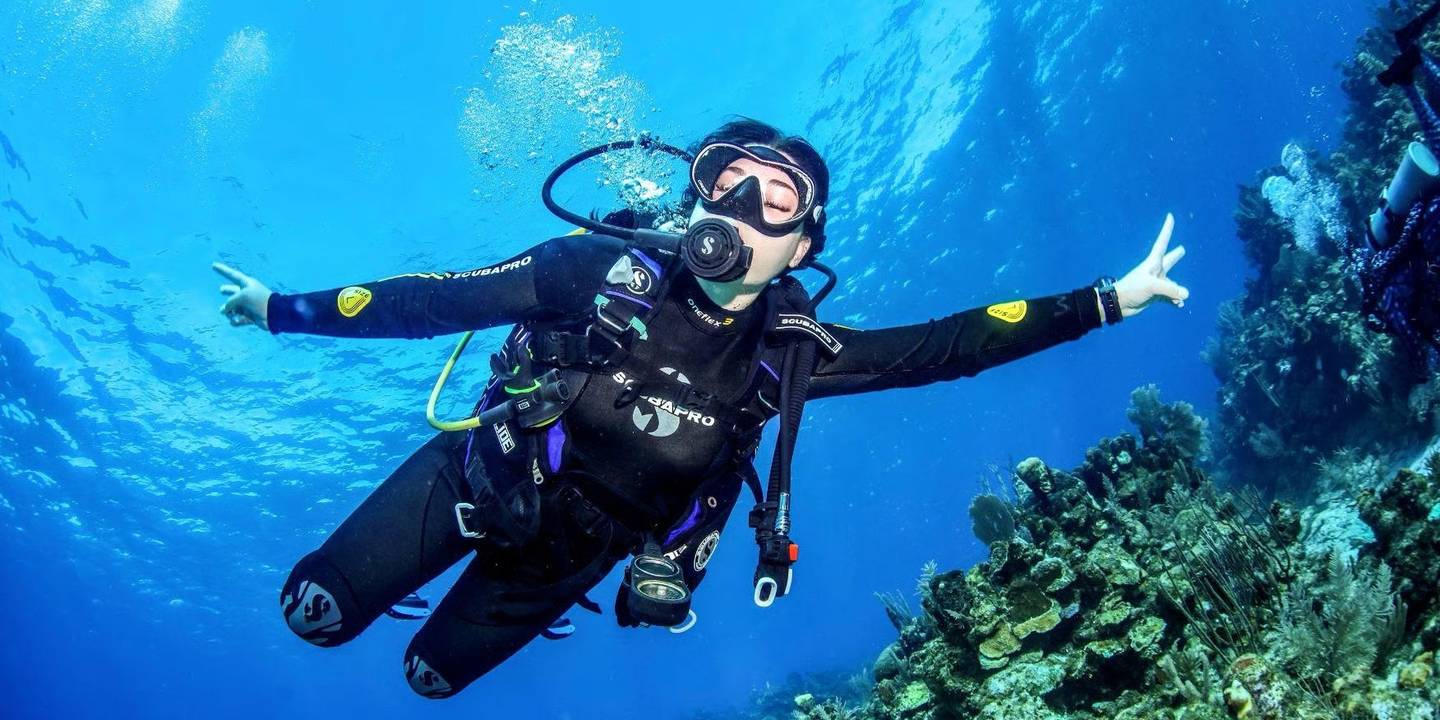
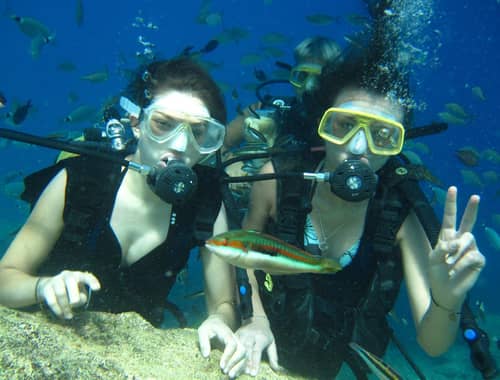
Scuba diving in Türkiye is open to complete beginners. On a typical holiday diving day you are briefed and trained on the boat, then make two short, shallow dives with an instructor close beside you, while certified divers join the same boat and dive in their own group. This guide explains what scuba diving is, where Maxtoria’s diving tours run, how a diving day usually unfolds, what a first dive involves and how to stay safe underwater.
Each tour sets its own programme, minimum age and swimming rules, so treat the patterns here as a guide and read the tour page before you book.
At a glance
Experience: none needed for a beginner dive; training is given before you go in
Depth for beginners: shallow — Türkiye’s underwater sports federation limits dives for people without a certificate to five metres
Dives: usually two in a day, each fairly short, with a rest and lunch on board in between
Who can dive: the national minimum age is 12; tours that state a minimum set it at 12 or 14
Usually included: hotel transfer, instructor, diving equipment and lunch
Cancellation: free up to 24 hours before the start on every Maxtoria tour
Scuba stands for self-contained underwater breathing apparatus. You carry your own air in a tank on your back and breathe it through a regulator, which reduces the tank’s high pressure so you can breathe normally from its mouthpiece. That lets you stay below the surface at eye level with the fish instead of looking down at them from above.
Scuba diving, snorkelling and swimming are three different activities, and a diving day can include all of them:
Scuba diving: you breathe from a tank while fully underwater. It needs an instructor for a try dive, or a certification course.
Snorkelling: you float face down at the surface with a mask, snorkel and fins, and can only go under for as long as you can hold your breath.
Swimming: no breathing equipment at all. Most diving days leave time to swim from the boat.
A try dive — also called a beginner dive or first dive — is a supervised introduction, not a qualification.
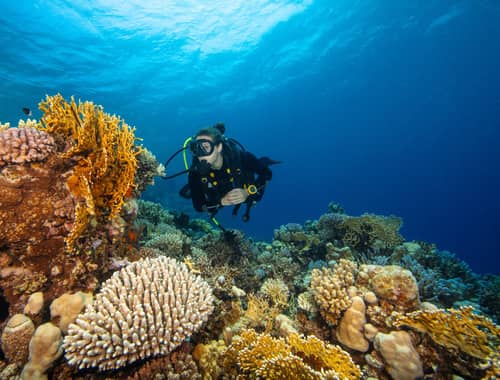
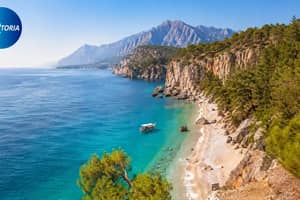
Türkiye has long Mediterranean and Aegean coastlines, and Maxtoria’s diving tours run from Side, Antalya, Alanya, Kemer and Marmaris. Underwater, the coast is rocky reef, rock formations and, in places, seagrass (Posidonia) meadows. There are no coral reefs in this part of the Mediterranean: expect usually calm summer seas, often good visibility and reef fish that often come close.
Side. Side lies on the Mediterranean east of Antalya, and its tours dive over the rocky reefs along this stretch of coast. A notable site is the Side Underwater Museum, Türkiye’s first underwater museum, opened in 2015 about 1.5 nautical miles off Side. Its more than 100 sculptures are modern works made for the site, not ancient ruins: figures from Turkish history and myth. The main sculpture groups lie at depths for certified divers, so beginners who dive there stay in the shallow part with their instructor. See scuba diving tours from Side.
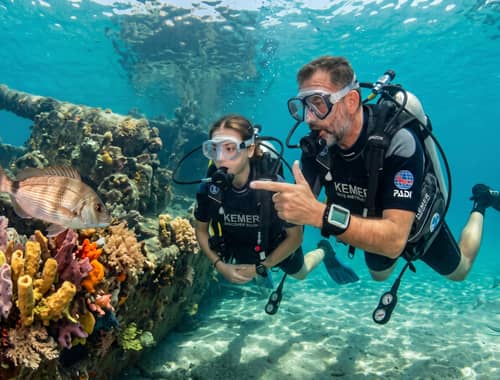
Antalya and Kemer. Kemer, south-west of Antalya, is a well-established diving resort with many dive schools. Tours sail from Kemer marina to sheltered bays such as Aquarium Bay, often used for first dives, and Cave Bay, a rocky bay with overhangs (beginners do not go into the caves). If you are staying around Antalya, the Antalya-area tours collect you from your hotel and drive about an hour to Kemer; the diving happens there, not off Antalya city. Compare scuba diving tours from Antalya and scuba diving tours in Kemer.
Alanya. Further east, the Alanya tours sail from harbours on the Alanya coast, including Okurcalar, west of the town, and one tour sold from Side drives guests east to dive there. See scuba diving tours in Alanya.
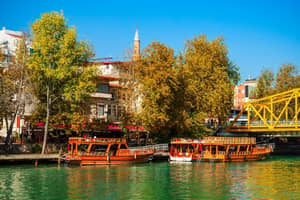
Marmaris. On the south-west coast, where the Aegean meets the Mediterranean, Maxtoria also lists a full-day diving trip with hotel pickup in Marmaris and İçmeler.
Maxtoria’s diving tours follow a similar pattern, though the order, times and sites vary by tour and on the day with the sea:
Hotel pickup — most tours collect you from hotels in their area, before the listed start time
Harbour or marina — you board the dive boat, sometimes after a road transfer of about an hour
Briefing and equipment — the instructors explain the kit and the dive plan
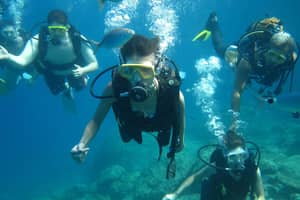
First dive — a shallow dive with your instructor beside you
Surface interval and lunch — a rest on deck, the break your body needs between two dives, with lunch served on board
Second dive — at a different site
Swimming and free time — most tours leave time to swim from the boat or relax on deck
Return and drop-off — back to the harbour, then the transfer to your hotel
For example, Maxtoria’s Side scuba diving tour runs from 09:30 to 16:00 from Side Harbour. The first dive is about 20 minutes at around five metres over a shallow rocky reef; after a surface interval of about 70 minutes and a hot lunch, the second dive of about 20 minutes is at the Side Underwater Museum site, followed by about 75 minutes of swimming and free time. Its guide languages are English and Turkish. Other tours start at different times, and guide languages differ too, so check the tour page.
Scuba diving for the first time is more about staying calm than being brave, and no certificate or previous dive is needed.
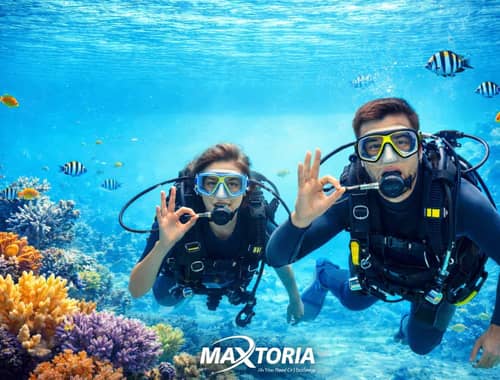
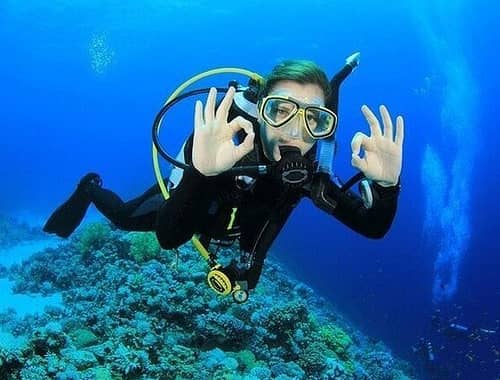
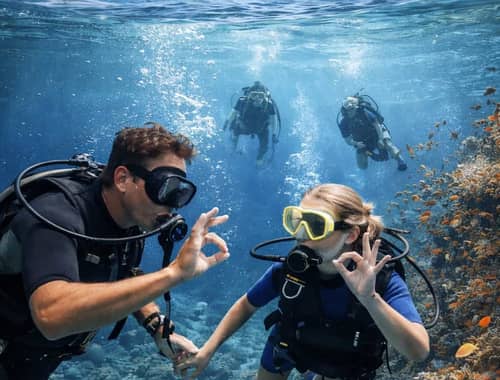
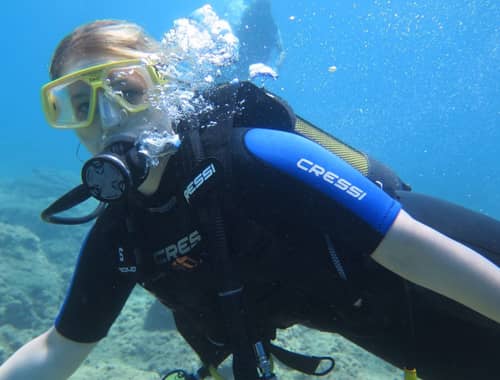
Before the first dive the instructors explain the kit and the dive plan. Beginners are usually also shown a few hand signals for underwater, such as OK, problem, up and ear trouble. You may be asked health questions, and in Türkiye divers sign a declaration, in Turkish and a language they understand, that they know the safety rules and accept the risks of diving. Then you are fitted with your equipment — typically a mask, fins, a buoyancy jacket and weights, usually with a wetsuit. Ask for another size if anything pinches or feels loose.
Beginners usually practise a few simple skills near the surface before going further down: breathing slowly through the regulator, letting a little water out of the mask, finding and replacing the mouthpiece, and equalising the ears by pinching the nose and blowing gently. The first minute can feel strange. Then it settles.
Your instructor stays close to you, sets the pace and the direction, and keeps contact with you throughout; on the Side tour, for example, the instructor works one to one with each beginner. Signal if anything feels wrong — an ear that will not clear, a mask that lets in water, or simply wanting to go up.
Not deep. Türkiye’s underwater sports federation (TSSF) defines an introductory dive for people without a certificate as a shallow dive, supervised one to one by an instructor, to a maximum of five metres. That is deep enough to feel properly underwater and shallow enough for plenty of light and colour. On the Side tour, for example, the first dive is at around five metres over a shallow rocky reef.
If you already hold a certification, many of the same tours take you too. You usually join the same boat and are grouped separately once the dive plan is set; on the Side tour, for example, deeper and longer dives can be arranged with the guide on the day. Mention your level and your last dive when you book.
Bring your certification card, and your logbook if you keep one; some tours ask for the card before you can dive at your own level. If you have not dived for six months or more, training agencies such as PADI recommend a refresher, so say so before you get in.
In Türkiye, certified visitors dive under the supervision of the dive centre’s guide rather than independently, and solo diving is not allowed. Depth limits follow your training: as an agency norm, an Open Water diver is qualified to 18 metres and an Advanced Open Water diver to 30 metres (adult limits; junior certifications can be shallower). At the Side Underwater Museum, the sculpture groups lie at about 11, 18 and 24 metres, according to Turkish news agencies.
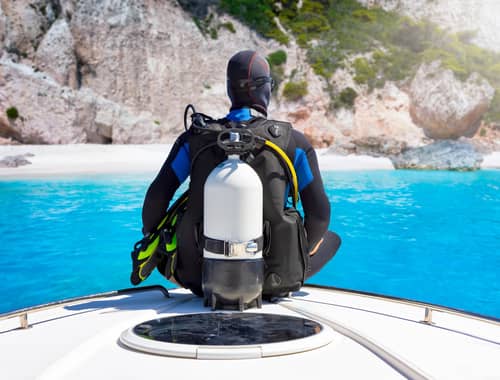
Item | What it does |
|---|---|
Mask | Lets you see clearly underwater |
Snorkel | Lets you breathe at the surface without lifting your face |
Wetsuit | Keeps you warm and protects your skin |
Fins | Let you move with slow, easy kicks |
BCD (buoyancy jacket) | A vest you inflate or deflate to float, sink or hover; it also holds the tank |
Regulator | Reduces the tank’s pressure so you can breathe from its mouthpiece; a spare (the octopus, often yellow) is for emergencies |
Tank | Holds the compressed air you breathe |
Weights | Offset the buoyancy of your body and wetsuit so you can descend |
Dive computer or gauges | Track depth, time and remaining air; on a beginner dive your instructor keeps an eye on them |
Diving equipment is normally included and handed out on the day, so you do not need to bring any gear of your own; check the tour’s inclusions to be sure.
Each tour page lists its inclusions; the common pattern is:
Hotel pickup and drop-off within the tour’s area
Two guided dives, usually at different sites
A diving instructor throughout
Diving equipment, and on some tours a life jacket
Lunch on board
The boat trip itself
Drinks on board
Photos and videos of your dives — optional photos can often be bought, so bring a little cash
Personal expenses and tips
Insurance varies. Some tours list insurance among their inclusions, while others list personal travel insurance as not included. Check the tour page, and make sure your own travel insurance covers recreational scuba diving.
Most of Maxtoria’s diving tours are full-day trips, starting between about 09:30 and 10:00 and returning in the late afternoon, plus the hotel transfer before and after; at least one Kemer tour is a shorter morning trip. Only a small part of the day is spent underwater. On the Side tour, for example, the two dives add up to about 40 minutes; the rest is the briefing, sailing, the surface interval, lunch and time to swim.
On a beginner dive your instructor handles most of the rules, but these are worth knowing before you board:
Listen to the briefing, and tell the team if any of your equipment feels wrong.
Stay with your instructor and your group. In Türkiye nobody dives alone.
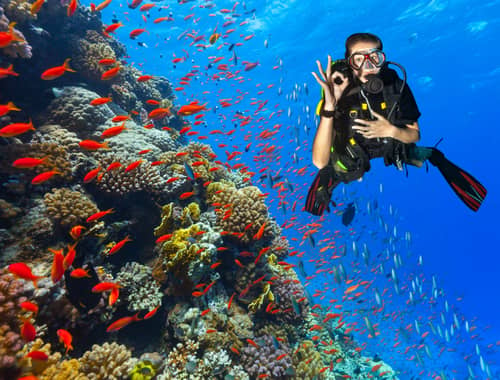
Learn the hand signals and use them, especially for a problem or ear trouble.
Equalise early and often on the way down. If an ear hurts, stop and signal your instructor, who will take you up a little so you can try again — never force it.
Never hold your breath. Breathe slowly and continuously, and come up slowly as your instructor directs.
Avoid alcohol before diving, and do not dive if you feel unwell.
Stay within your training; a beginner dive is not a certification.
Health and medication. Tell the dive team about any medical condition or medication before you book; several tours, including the Side tour, ask for this. Dive centres use a standard diver medical questionnaire, and a “yes” to certain questions usually means you need a doctor’s approval before diving. If in doubt, ask a doctor, ideally one familiar with diving. The standard questionnaire advises against diving while pregnant, and the tours in this category that mention pregnancy say diving is not suitable.
Flying after diving. Divers Alert Network (DAN) guidance is to wait at least 12 hours after a single dive and at least 18 hours after multiple dives in a day or diving on consecutive days — and a two-dive day counts as multiple dives. Some tour pages advise a longer wait; where a tour’s advice is stricter, follow it. Do not book your dive day just before your flight home.
Local rules. Türkiye protects its underwater heritage strictly. Touching, moving or bringing up anything from the seabed, whether historic or natural, is prohibited; sport diving is banned in designated protection zones except at approved sites; and spearfishing with scuba is illegal. If you are unsure whether something is allowed, ask your instructor.
On the rocky reefs of Türkiye’s Mediterranean coast you may see schools of bream and bogue, wrasses and small damselfish, and with luck an octopus, a cuttlefish or a moray eel tucked into a crevice. Groupers, barracuda and stingrays are also recorded along the Antalya coast, and loggerhead turtles are occasionally seen by divers in summer. Nothing is guaranteed: it depends on the site, the season and the day.
Two newcomers are worth recognising. Lionfish, an invasive species with venomous spines, have reached Antalya Bay. The silver-cheeked toadfish, a large invasive pufferfish, is poisonous to eat and can bite. Look at both, and touch neither.
Touch nothing: reef life is easily damaged, and some residents sting or bite.
Take nothing: shells, stones and anything historic stay where they are.
Keep your fins off the bottom and away from seagrass meadows, which shelter young fish.
Do not feed fish or other wildlife unless the dive team specifically allows it; feeding changes their natural behaviour.
Give turtles and other large animals space, and never chase or touch them.
Keep hoses and gauges tucked in so nothing drags across the reef.
Leave every site exactly as you found it.
Choose a tour from the list on this page, pick a date and add your group; your pickup time is confirmed after booking. Most tours can be booked up to five hours before the start. Depending on the tour, you can pay online by card or, if you are signed in to your account, on the day. Every tour can be cancelled free of charge up to 24 hours before the start. Before you book, check the tour page for its minimum age, swimming requirement and what is included, and ask Maxtoria support if anything is unclear.
Tours and activities in Scuba Diving from licensed local operators.
Diving equipment is normally provided, so there is no need to pack a mask or fins. Eat a light breakfast before pickup. If you get seasick, mention it when you book and ask a doctor before taking any remedy, as some cause drowsiness.
For a first dive, June to October is the most comfortable time on the south coast: the sea is usually above 23 °C and summer seas are usually calm. Most dive boats on this coast run from about April or May to October or November. According to long-term averages from Türkiye’s State Meteorological Service (MGM), the Mediterranean surface water is warmest in August, at around 28 °C, and coolest in February, at around 16–17 °C. It is cooler at depth, so a wetsuit is usual.
Rough seas are far more common between November and March, and dive crews may switch sites or postpone when the sea is unsafe. For winter dates, check availability on the tour page. For month-by-month weather on the south coast, see the best time to visit Antalya.
Türkiye’s underwater sports federation (TSSF) sets 12 as the minimum age for any scuba diving, including try dives. Tours set their own minimum: those that state one accept divers from 12 or from 14, so check the tour page.
Yes. Maxtoria’s diving tours are open to complete beginners, and many also take certified divers. Training is given before the first dive, and an instructor stays close beside you underwater, so you need no previous experience.
No. You need no licence and no previous dive to join as a beginner. A try dive is not a certification either: it is a supervised introduction that shows you whether you would like to take a course later. Some tours hand out a participation certificate, which is a souvenir rather than a diving qualification.
Not deep. As a national rule, Türkiye’s underwater sports federation (TSSF) defines an introductory dive for people without a certificate as a shallow, one-to-one supervised dive to a maximum of five metres. On the Side tour, for example, the first dive is at around five metres over a shallow rocky reef.
Most tours are full-day trips from the morning to the late afternoon, plus the hotel transfer, though at least one Kemer tour is a shorter morning trip. The time underwater is much shorter: on the Side tour, for example, two dives of about 20 minutes each, with a long rest and lunch on deck in between.
Most tours include hotel pickup and drop-off, two guided dives, an instructor, diving equipment and lunch on board. Drinks, dive photos and videos, personal expenses and tips are usually extra. Insurance varies: some tours include it and others do not, so check the tour page and your own travel insurance.
Yes. Diving equipment is normally included and handed out on the day, and some tours also provide a life jacket, so you do not need your own mask, fins or wetsuit; the tour page lists what is included. If you want to use your own mask or dive computer, ask the team when you book.
Türkiye’s underwater sports federation (TSSF) sets the minimum at 12 for any scuba diving, including try dives. Tours that state a minimum set it at 12 or 14, and divers must be in good health. Check the tour page; on the Side tour, for example, divers must be 14 or older, and younger guests can spend the day on the boat.
It depends on the tour. Some tour pages say non-swimmers can take part because the instructor works one to one underwater, while others require basic swimming. Either way, being comfortable in the water makes the dives far more enjoyable, so tell the team in advance if you cannot swim.
A swimsuit, a towel, dry clothes, sunscreen, sunglasses and a hat, plus a little cash for drinks or optional photos. Certified divers should bring their certification card, and their logbook if they keep one. Diving equipment is provided, so there is no need to pack any.
The instructors explain the kit and the dive plan and give you training before anyone goes into the water. Beginners usually also learn a few hand signals and practise breathing through the regulator and equalising their ears near the surface. You may be asked health questions, and in Türkiye divers sign a safety declaration.
Yes. Your instructor stays close to you, sets the pace and keeps contact throughout. Feeling nervous before a first dive is normal. Tell your instructor before you get in, take your time at the surface, and signal whenever you want to stop or go up.
Yes, on many tours. Certified divers usually join the same boat and are grouped separately once the plan is set, and deeper or longer dives may be arranged within your training. Bring your certification card, and your logbook if you keep one; in Türkiye certified visitors dive with the dive centre’s guide, not independently.
Photos and videos are usually not included in the price, but optional photos can often be bought on board, so bring a little cash if you want them. If you plan to take your own camera, ask your instructor first; on a first dive, keeping your hands free is usually easier.
Dive crews choose and adjust sites for the sea conditions, and they may postpone a trip when the sea is unsafe. If your plans change, you can cancel free of charge up to 24 hours before the start, or contact Maxtoria support about another date.
On most tours, yes, for hotels within the tour’s area. Pickup is earlier than the listed start time, and your exact pickup time is confirmed after you book, depending on where your hotel is. Some tours include a road transfer of about an hour, for example from Antalya to Kemer.
Divers Alert Network (DAN) recommends waiting at least 12 hours after a single dive and at least 18 hours after multiple dives in a day or diving on consecutive days. A two-dive day counts, so do not book your dive day just before your flight home. Some tour pages advise 24 hours; where a tour’s advice is stricter, follow it.
It depends on where you are staying. Maxtoria’s diving tours run from Side, Antalya, Alanya, Kemer and Marmaris; the Antalya tours dive in the bays around Kemer. Side is known for its underwater museum, and Kemer for sheltered bays often used for first dives. Choosing a tour near your hotel keeps the transfer short.
For a first dive, June to October is the most comfortable time on the south coast, with the sea usually above 23 °C and generally calm. August is the warmest month. Most dive boats run from about April or May to October or November, so check availability for other dates.
Our easy-to-use app offers a comprehensive listing of curated tours, activities, and experiences, all in one place. Whether you’re a thrill-seeker looking for an adrenaline-packed adventure or seeking a more relaxed getaway, Maxtoria has got you covered.





© 2026 Maxtoria Turizm Ticaret A.Ş. — All Rights Reserved
v2.1.2