







City Tour
Antalya Full-Day City Tour with Waterfalls, Boat Trip & Lunch
Free Cancellation Free Shuttle
From £19.68 £17.82 Per Person



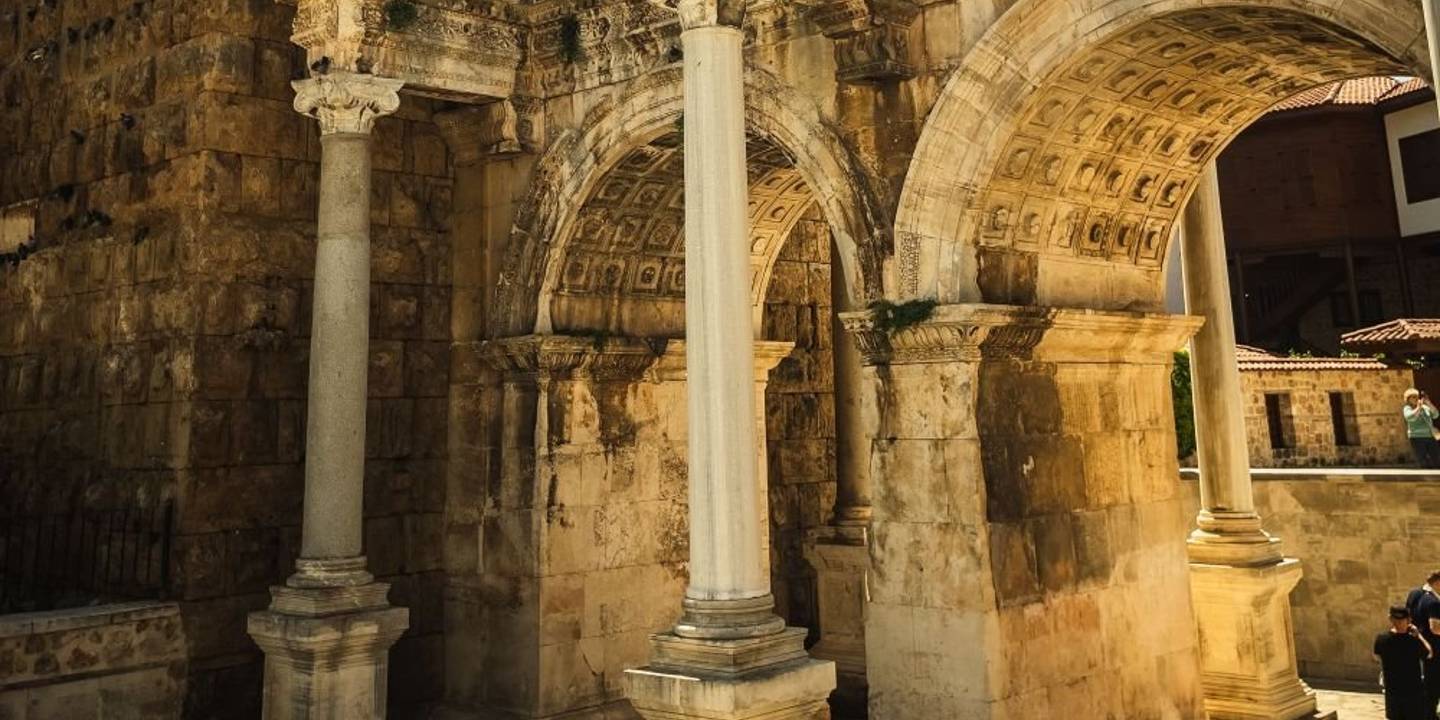
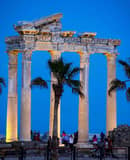
Hadrian’s Gate is a monumental Roman entrance located beside Atatürk Street at the eastern entrance to Kaleici in Antalya’s central Muratpasa district. It was constructed in AD 130 to commemorate Roman Emperor Hadrian’s visit to the ancient city of Attaleia. The gate is also known locally as Üçkapılar , meaning the Three Gates , because of its three arched passageways. With its white-marble façade, decorative carvings and towers from different historical periods, Hadrian’s Gate is one of Antalya’s best-preserved ancient monuments and a popular starting point for exploring the Old Town.
Tours and trips that go here, run by licensed local operators.
Hadrian’s Gate is located in the Muratpasa district of central Antalya, where Atatürk Street meets the historic Kaleici neighbourhood. The monument forms an impressive entrance between modern Antalya and the narrow streets of the Old Town.
Address:
Barbaros, Atatürk Street, Hadrian Kale Kapısı, 07100 Muratpasa, Antalya, Türkiye
The main transport options are:
On foot: Hadrian’s Gate is within walking distance of Republic Square, Antalya Clock Tower and the Yivli Minaret.
By tram: The heritage tram operating along Atatürk Street stops near the Üçkapılar area. A short walk is required after leaving the tram.
By public bus: Numerous city buses stop around Atatürk Street, Işıklar and central Antalya. Routes can change, so check the current municipal transport information.
By car: Driving through the narrow streets of Kaleici is restricted. Use a public or private car park around Atatürk Street, Işıklar or the outer walls and continue on foot.
By taxi: Ask to be dropped near Hadrian’s Gate, Üçkapılar or the Atatürk Street entrance to Kaleici.
By organised tour: Antalya city tours may combine Hadrian’s Gate with Kaleici, the Yivli Minaret, Clock Tower, Old Harbour and Duden Waterfall.
Approximate distances:
| Starting point | Distance to Hadrian’s Gate |
|---|---|
| Antalya Clock Tower | 500–700 m |
| Republic Square | 700–900 m |
| Old Harbour | 800 m–1 km |
| Hidirlik Tower | Approximately 1 km |
| Antalya Museum | 3–4 km |
| Antalya Bus Terminal | 8–10 km |
| Antalya Airport | 13–15 km |
There is no single answer to “How far is Hadrian’s Gate from Antalya city centre?” because the gate is already located in central Antalya. It marks one of the eastern entrances to the historic Kaleici district.
Hadrian’s Gate is free to visit. No museum ticket, entrance fee or Museum Pass is required to see the monument or walk through its arches.
| Visitor information | Details |
|---|---|
| Entrance to Hadrian’s Gate | Free |
| Ticket or Museum Pass | Not required |
| General access | Public outdoor monument |
| Recommended visit duration | 15–30 minutes |
| Visit combined with Kaleici | 1–3 hours |
| Guided city tours | Charged according to the selected tour |
| Nearby car parks | May charge separately |
Hadrian’s Gate is an outdoor monument and a public passage into Kaleici. Current visitor listings describe it as accessible throughout the day. Temporary restrictions may still be introduced for restoration, maintenance, security work or special events.
Early morning is the best time for quieter photographs and cooler temperatures. The illuminated gate and lively atmosphere of Kaleici make the evening another attractive time to visit.
Approximately 15–30 minutes is enough to see the gate and examine its architectural details. Allow at least two to three hours if you plan to continue through Kaleici to the Broken Minaret, Hidirlik Tower, Karaalioglu Park, Old Harbour and Yivli Minaret.
Hadrian’s Gate was built in AD 130 to commemorate Roman Emperor Hadrian’s visit to Attaleia, the ancient city that developed into modern Antalya. The monumental entrance was constructed within the defensive walls surrounding the ancient city and harbour.
The principal architectural features include:
Three adjoining arched passageways
Colonnaded façades on both sides
A structure made mainly from white marble
Decorative carvings and reliefs around the arches
Two towers dating from different historical periods
The Roman-era Julia Sancta Tower on the southern side
A northern tower with an ancient lower section and a Seljuk-period upper section
A second floor that formed part of the original structure but has not survived
An ancient road level below the height of the modern street
Over time, sections of the city walls enclosed the exterior of the gate, and the entrance remained unused for a long period. This may have helped protect its architectural details from damage. Hadrian’s Gate became visible again when sections of the surrounding walls were removed in 1882.
The monument does not represent only the Roman period. Its towers contain Roman, ancient and Seljuk-era elements, making Hadrian’s Gate an important example of Antalya’s layered urban history.
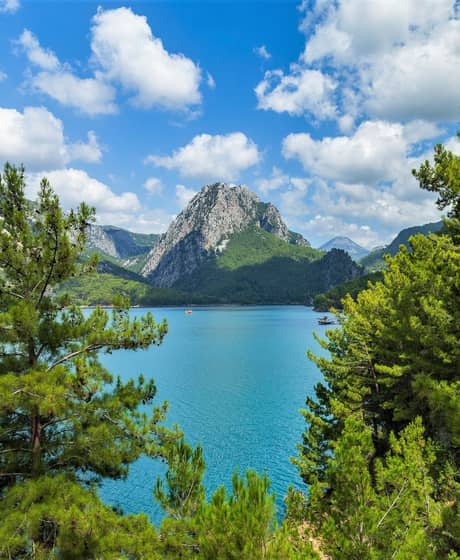
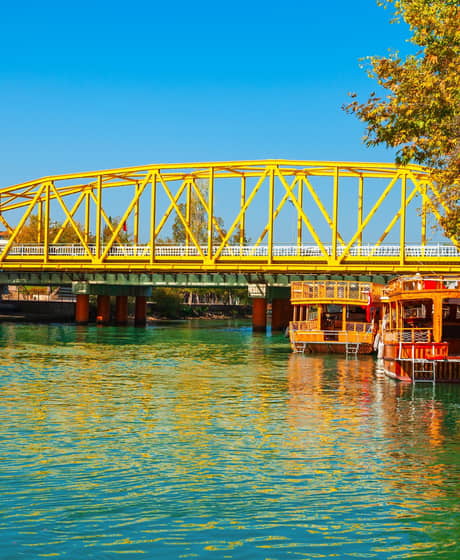
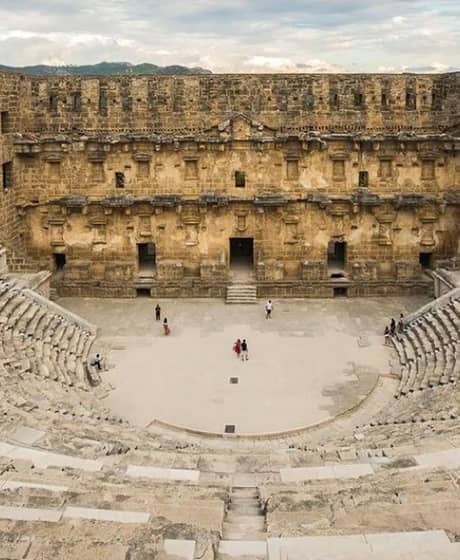
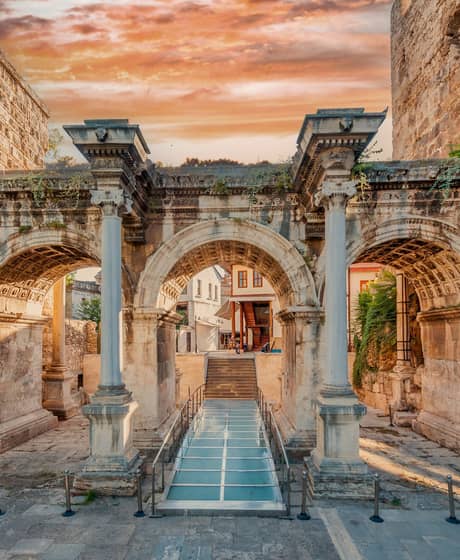
Hadrian’s Gate, also known as the Three Gates, is one of the most recognisable landmarks in Antalya’s historic centre. The Roman monument stands between modern Atatürk Street and the narrow lanes of Kaleici Old Town.
Walking through the arches takes visitors directly from the modern city into Antalya’s historic district. Hadrian’s Gate is therefore more than an individual monument: it is a natural starting point for a walking route through Kaleici.
Hadrian’s Gate is a monumental Roman entrance built into the defensive walls of ancient Attaleia. It can be described as a ceremonial city gate, monumental arch or Roman triumphal-style entrance.
Although the gate formed part of the city’s defensive system, its purpose was not purely military. It created an impressive ceremonial entrance commemorating Emperor Hadrian’s visit and demonstrated the importance of Attaleia within the Roman Empire.
Hadrian’s Gate was constructed in AD 130 to commemorate Roman Emperor Hadrian’s visit to Attaleia. The monument is therefore approximately 1,900 years old.
Hadrian ruled the Roman Empire from AD 117 to 138 and was known for travelling extensively through the provinces. Monumental gates, temples and public buildings were sometimes constructed to mark imperial visits.
Hadrian’s Gate was constructed during the Roman period in honour of Emperor Hadrian. However, the name of the architect or individual responsible for its construction is not known with certainty.
It is therefore more accurate to say that the gate was commissioned by the Roman authorities to commemorate Hadrian’s visit than to claim that Emperor Hadrian personally built it.
The gate was created to welcome and honour Emperor Hadrian during his visit to Attaleia in AD 130. Its monumental design turned the emperor’s entrance into a ceremonial event while displaying Roman architectural and political power.
The principal purposes of Hadrian’s Gate included:
Commemorating the emperor’s visit
Providing a monumental entrance to Attaleia
Controlling access through the city walls
Demonstrating Roman authority and architectural skill
Emphasising the importance of Attaleia as a Mediterranean port
The story of Hadrian’s Gate is connected to Emperor Hadrian’s journeys through the Roman provinces. When his visit to Attaleia was announced, a monumental entrance was built to welcome and honour him.
During later centuries, the gate became enclosed within Antalya’s defensive walls. Sections of wall blocked its exterior, and the entrance was no longer used as an active passage for a long period. This enclosure may have helped protect its marble façade and decorative details.
Hadrian’s Gate became visible again when parts of the surrounding walls were removed in 1882. Later restoration work helped preserve the structure and return it to use as one of the principal entrances to Kaleici.
The Turkish name Üçkapılar means the Three Gates and refers to the monument’s three adjoining arched passageways. Searches for “Three Gates Antalya”, “Antalya Three Gates” and “Üç Kapılar” all refer to Hadrian’s Gate.
Although the three arches follow a similar architectural arrangement, the towers beside them were not constructed entirely during the same period. This allows visitors to see Roman and Seljuk architectural elements within the same monument.
The most recognisable feature is the white-marble façade containing three arches. A colonnaded arrangement was used on both sides, while the arches and upper architectural elements were decorated with carvings, floral motifs and reliefs.
The original gate is believed to have had two storeys. Only the lower section survives today. Statues or imperial representations may once have stood on the upper level, although this part of the monument has not survived.
The ancient road beneath the gate is lower than modern Atatürk Street. The original Roman pavement and worn stone surfaces can be observed beneath the protected crossing.
The two towers beside Hadrian’s Gate reveal different periods of Antalya’s history.
The southern tower, known as the Julia Sancta Tower, dates from the Roman period. Although it does not follow exactly the same architectural arrangement as the central gate, it is associated with the Hadrianic era.
The lower part of the northern tower dates from antiquity. Its upper section was reconstructed or repaired during the Seljuk period. A Seljuk inscription indicates that the structure continued to form part of Antalya’s defensive system long after the Roman era.
Historical sources describe a Latin inscription associated with Hadrian’s Gate. Bronze letters forming a dedication to Emperor Hadrian are believed to have been positioned on the upper section of the monument.
The original upper floor and complete inscription arrangement have not survived. Visitors today can see only the preserved sections of the ancient structure.
The original Hadrian’s Gate was taller than the monument visible today. It is believed to have had two levels, with additional architectural decoration, inscriptions and possibly statues on the upper floor.
The gate later became hidden behind sections of the city walls and remained out of active use for a long period. It became visible again after wall remains were removed in 1882 and was subsequently protected through restoration work.
The surviving monument primarily consists of the lower level, its three arches and the towers standing on either side.
Yes, Hadrian’s Gate is free to visit. No ticket is required to see the monument, photograph the façade or walk through the arches into Kaleici.
Guided Antalya city tours that include Hadrian’s Gate, transportation services and nearby car parks may charge separately.
Hadrian’s Gate is an outdoor monument and public entrance to Kaleici rather than a ticketed museum. It does not have conventional museum opening and closing hours and is generally accessible throughout the day.
Access can temporarily change during restoration, maintenance, security work or public events. Individual museums, mosques and attractions within Kaleici follow their own opening hours.
Approximately 15–30 minutes is enough to see the gate, examine the architectural details and take photographs.
Visitors who want to continue through Kaleici can follow this walking route:
Hadrian’s Gate
Kaleici streets and traditional houses
Broken Minaret and Korkut Mosque
Hidirlik Tower
Karaalioglu Park
Old Harbour
Yivli Minaret
Antalya Clock Tower
Republic Square
Without long museum, shopping or meal stops, the route can be completed in approximately two to three hours.
Early morning is usually the best time for fewer crowds, cooler temperatures and clearer views of the architectural details. Strong summer sunlight around midday can create harsh shadows across the marble façade.
The gate is illuminated in the evening, creating a different atmosphere. Kaleici becomes busier at this time, so taking an unobstructed photograph may be more difficult.
Visitors should not climb on ancient surfaces, touch the carvings or block the passage while taking photographs.
Hadrian’s Gate can be visited with children. However, young children should be supervised because of uneven ancient surfaces, steps, crowds and the surrounding roads.
Wheelchair users and visitors with pushchairs may encounter difficulty because of level changes and historic paving. Temporary conservation arrangements can also change the most accessible route.
Hadrian’s Gate is within walking distance of many attractions in central Antalya:
Kaleici streets
Broken Minaret
Hidirlik Tower
Karaalioglu Park
Mermerli Beach
Old Harbour
Yivli Minaret
Antalya Clock Tower
Republic Square
Suna & Inan Kıraç Kaleici Museum
These places can be combined with Hadrian’s Gate to create a half-day central Antalya walking itinerary.
Yes. Hadrian’s Gate stands at the eastern entrance to Kaleici and connects the Old Town with Atatürk Street.
Visitors can walk through the three arches and continue directly into Kaleici’s narrow lanes. This makes the gate one of the easiest and most atmospheric starting points for exploring Antalya Old Town.
No. Hadrian’s Gate in Antalya is different from Hadrian’s Arch in Athens, the Temple of Hadrian in Ephesus and structures associated with Hadrian in Phaselis.
This guide covers the Hadrian’s Gate located at the entrance to Kaleici in Muratpasa, Antalya.
Hadrian’s Gate can be visited independently or as part of an organised Antalya city tour. A guided programme is suitable for travellers who want to combine hotel transfers, Kaleici, Duden Waterfall, the Old Harbour and a boat trip in a single day.
Compare Antalya tours and activities, explore the best places to visit in Antalya, or review the Antalya city tour with waterfalls, Old Town and a boat trip.
Our easy-to-use app offers a comprehensive listing of curated tours, activities, and experiences, all in one place. Whether you’re a thrill-seeker looking for an adrenaline-packed adventure or seeking a more relaxed getaway, Maxtoria has got you covered.





© 2026 Maxtoria Turizm Ticaret A.Ş. — All Rights Reserved
v2.1.2