















- Places to SeeThings to DoDownload the App


About Temple of Apollo in Side
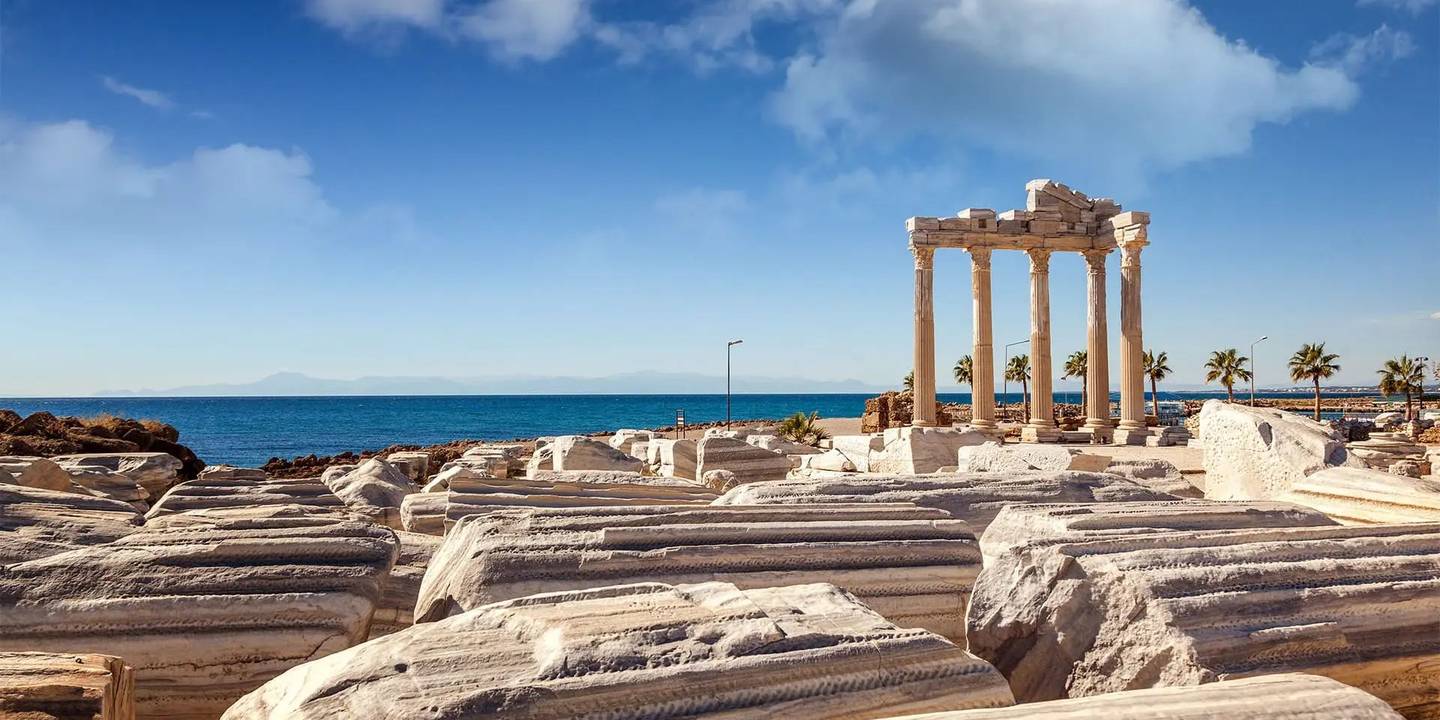
The Temple of Apollo in Side is a Roman-period temple located beside the ancient harbour at the southern end of Side Ancient City in the Manavgat district of Antalya. Built in the mid-2nd century AD in the Corinthian order and dedicated to Apollo, one of Side's principal deities, the monument is one of the resort's most recognisable landmarks with its five re-erected columns, seafront setting and sunset views. The public areas around the temple are normally free to visit and do not require a Museum Pass. However, extensive conservation, structural reinforcement and restoration work continued at the temple in 2026, so access to the immediate surroundings may be restricted at different stages of the project. Visitors can still see the columns from nearby walking routes but should follow the current barriers, signs and site rules.
No trips to this one just yet
Have a look at everything else you can book in Side.
All activities in SideWhere Is the Temple of Apollo in Side and How Do You Get There?
The Temple of Apollo is at the southern end of the Side peninsula, beside the ancient harbour and coastal walking route. Administratively, it lies in Selimiye, Manavgat, Antalya. The site is approximately 7–8 kilometres from central Manavgat and around 75–80 kilometres from Antalya city centre, depending on the route.
The main transport options are:
-
On foot: From the entrance to Side Ancient City, walk towards the colonnaded street, ancient theatre and Old Side. The journey to the temple usually takes 15–30 minutes, depending on your starting point.
-
By public transport: Current buses or minibuses travelling from Manavgat to Side can be used. The final section is normally completed on foot within the peninsula.
-
By taxi: Taxis can take visitors from hotels in Side, Kumköy, Evrenseki, Sorgun, Titreyengöl and Manavgat to the entrance of Old Side.
-
By car: Vehicle access may be restricted in the historic peninsula. Park in a suitable area near Side Ancient City or Old Side and walk the remaining distance.
-
By tour: Some Side and Manavgat excursions provide free time around the ancient city, theatre and Temple of Apollo. Confirm that the temple is clearly included in the itinerary.
For navigation, search for Temple of Apollo Side, Side Apollon Tapınağı or Apollon Temple Side. Check that the result points to the Side peninsula in Manavgat; the temples of Apollo in Didim, Delphi and other locations are different monuments.
Is the Temple of Apollo in Side Open and Is There an Entrance Fee?
The public walking and viewing areas around the Temple of Apollo are normally free, and no separate ticket or Museum Pass is required solely to see the monument. Admission charges for Side Museum and the ancient theatre do not constitute an entrance fee for the Temple of Apollo.
| Visitor information | Current arrangement |
|---|---|
| Viewing the temple from public routes | Free |
| Separate Temple of Apollo ticket | Normally not required |
| Museum Pass | Not required for the open public surroundings |
| Side Museum and ancient theatre | Separate visitor conditions may apply |
| Direct access to the restoration area | May be restricted for safety |
| Parking, guiding and private tours | May be charged separately |
Restoration and structural reinforcement work continued at the Temple of Apollo in 2026. The immediate area around the columns may therefore be fenced off, viewing angles can change and visitors may not be admitted to the work zone. Although the overall silhouette can usually be seen from nearby public paths, describing the temple as “open” does not mean that visitors can enter the ruins or restoration area.
Different completion dates have been published online. Instead of relying on a fixed reopening date, check current announcements from Side Museum Directorate, the official excavation channels or signs at the site on the day of your visit.
What Is the History and Story of the Temple of Apollo in Side?
The Temple of Apollo in Side was built around AD 150, during the prosperous period often associated with the Pax Romana, and was dedicated to Apollo. It is commonly dated to the reign of Antoninus Pius between AD 138 and 161.
Apollo was associated with light, music, poetry, prophecy, healing, order and harmony in the Greek and Roman worlds. The temple formed part of a sacred precinct connected to the sea and harbour. The larger neighbouring temple is generally identified as the Temple of Athena, honouring Side's patron goddess.
The popular story linking the temple to the romance of Cleopatra and Mark Antony is a modern tourism legend rather than an archaeologically documented account. Cleopatra and Mark Antony lived in the 1st century BC, while the surviving temple was constructed roughly two centuries later. Its verifiable story concerns Roman Side's prosperity, harbour life and the local cult of Apollo.
More to see around Side

Temple of Apollo in Side Travel and Visitor Guide
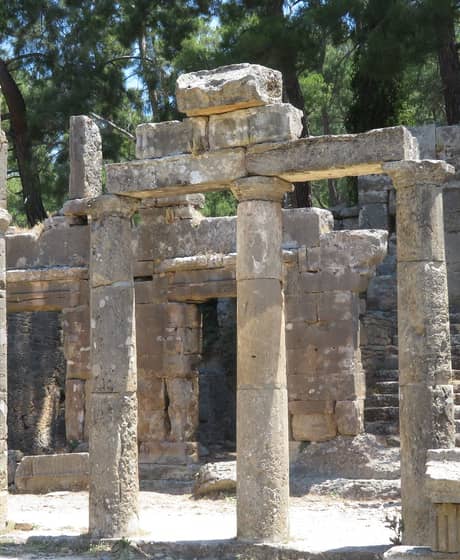
The Temple of Apollo in Side is one of Türkiye's best-known archaeological landmarks, combining ancient architecture with a Mediterranean coastal setting. The five columns, capitals, architrave and frieze sections visible today are not the complete temple; they represent a reconstructed section assembled during modern restoration using original architectural elements from the site.
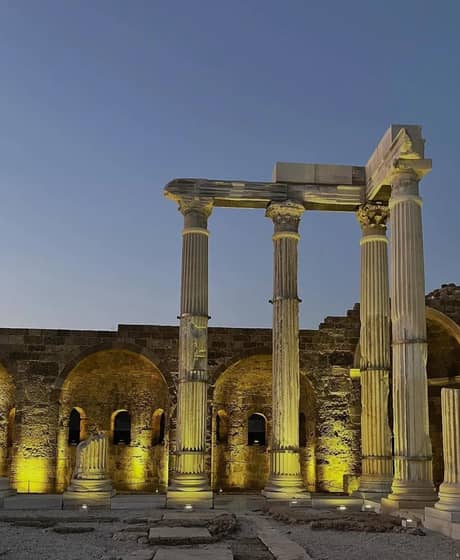
The temple should be understood as part of Side Ancient City together with the harbour, sacred precinct, Temple of Athena, southern basilica and surrounding coastal structures. Exploring the wider ancient city makes the monument's role in Roman religious and civic life easier to appreciate.
What Is the Temple of Apollo in Side?
The Temple of Apollo in Side is a 2nd-century Roman temple built in honour of Apollo in the ancient city of Side. Designed in the Corinthian order, it stands near the entrance to the ancient harbour at the southern end of the peninsula.
Its striking seafront silhouette has become closely associated with Side's visual identity. However, the five standing columns represent only a small section of the original monument. Foundation traces and architectural blocks around the area show that the complete temple was substantially larger.
The monument is not the same as the famous oracle temples at Didyma or Delphi. Its importance lies in its dedication to one of Side's principal deities and its place within the sacred architecture of the harbour district.
Where Is the Temple of Apollo in Side?
The Temple of Apollo is at the southern end of Side Ancient City, directly beside the ancient harbour and the Mediterranean coast. Its modern location can be written as Side, Selimiye, Manavgat, Antalya.
Old Side and the ancient ruins lie to the north, the foundations of the Temple of Athena are nearby, and the coast extends to the south and west. Because the monument is within Old Side's pedestrian network, the final part of the journey is normally completed on foot.
If a map result points to Didim in Aydın Province, it is the wrong Temple of Apollo. The correct result should also show Side Ancient City, Side Harbour and Manavgat.
Which City Is the Temple of Apollo in Side Located In?
The Temple of Apollo in Side is in the Manavgat district of Antalya Province. It is commonly described simply as being “in Side”; today, Side is a neighbourhood and tourism destination within Manavgat.
The temple is not in Antalya city centre. Travelling from central Antalya requires an eastbound road journey of approximately 75–80 kilometres, while the route from central Manavgat is considerably shorter.
Searches for “Antalya Temple of Apollo” usually refer to this monument, but travellers should confirm that their destination is Side in Manavgat.
Is the Temple of Apollo Inside Side Ancient City?
Yes, the Temple of Apollo is in the harbour and sacred precinct at the southern end of Side Ancient City. One of the ancient city's monumental streets extended towards the square near the temples.
Side Ancient City is a large, living archaeological settlement. Modern Old Side streets, businesses and ancient remains occupy the same peninsula, so the entire ancient city is not enclosed behind one gate or covered by a single ticket.
Specific attractions such as the ancient theatre and Side Museum may be ticketed, while the Temple of Apollo can normally be seen from a public pedestrian route. Safety restrictions during restoration are applied separately.
When Was the Temple of Apollo in Side Built?
The Temple of Apollo in Side was built around AD 150, during the reign of the Roman emperor Antoninus Pius. This dating is based on its architectural style, decoration and Side's development during the Roman period.
The reign of Antoninus Pius from AD 138 to 161 was a relatively stable and prosperous period in the Roman Empire. Side also flourished during the 2nd and 3rd centuries AD through its harbour, commerce and monumental public buildings.
Because no single foundation document provides an exact completion date, “around AD 150” or “the middle of the 2nd century AD” is the more accurate wording.
How Old Is the Temple of Apollo in Side?
The Temple of Apollo in Side is approximately 1,875 years old as of 2026. This estimate is calculated from its approximate construction date of AD 150; a small variation is expected because the precise foundation year is unknown.
The columns visible today have not all remained standing in their present arrangement for nearly two millennia. Some of the fallen original elements were reassembled during 20th-century anastylosis and restoration work.
The age of the ancient monument should therefore be distinguished from the date of its modern reconstructed appearance.
Who Built the Temple of Apollo in Side?
No individual architect or patron of the Temple of Apollo in Side is known by name. The monument is associated with the civic and religious building programme of Roman Side in the 2nd century AD.
Dating the temple to the reign of Antoninus Pius does not mean that the emperor personally commissioned it. In ancient cities, temples could be financed by civic authorities, local elites, priestly institutions or donors.
The safest answer to “Who built the Temple of Apollo?” is that it was commissioned by the Roman-period community of Side, while the identity of its architect remains unknown.
Who Was the Temple of Apollo in Side Dedicated To?
The temple was dedicated to Apollo, one of the principal deities worshipped in ancient Side. Apollo was associated with light, music, poetry, prophecy, healing, order and harmony.
He may also have held a protective role connected to seafaring and harbour life in Side. The temple's position near the ancient harbour supports this interpretation, although the local cult should not be assumed to have been identical to Apollo traditions at Didyma or Delphi.
The neighbouring temple is generally considered to have been dedicated to Athena, Side's patron goddess. Placing two major temples beside one another suggests that the city's leading god and goddess were jointly honoured in the harbour district.
What Is the Story of the Temple of Apollo in Side?
The historical story of the Temple of Apollo begins with prosperous Roman Side creating a monumental sacred area near its harbour for Apollo and Athena. The temple eventually lost its religious function, collapsed and left architectural elements scattered around the site.
As Christianity spread in Late Antiquity, pagan temples ceased to function and a large basilica was constructed around the temple precinct. Earthquakes, coastal conditions, the reuse of building materials and centuries of natural erosion all contributed to the state of the remains.
Excavation and restoration in the 20th century re-erected five columns, creating the silhouette that later became one of Side's best-known symbols.
Is the Love Story of the Temple of Apollo in Side True?
The love story connecting Cleopatra and Mark Antony to the Temple of Apollo in Side has not been historically verified. There is no reliable archaeological evidence that Antony gave the temple to Cleopatra or had it built for her.
The chronology also contradicts the story. Cleopatra and Mark Antony lived in the 1st century BC, whereas the Temple of Apollo visible in Side is dated to around AD 150. The monument was constructed roughly two centuries after their lifetimes.
The romantic account is best understood as a modern tourism legend inspired by Side's sunset atmosphere. The temple's documented significance belongs to the religious and architectural history of Roman Side.
What Is Apollo's Mythological Story?
In Greek mythology, Apollo is the son of Zeus and Leto and the twin brother of Artemis. His birth story tells how Leto, pursued under pressure from Hera, gave birth to the twins on the island of Delos.
Apollo's best-known myths include defeating Python at Delphi, establishing an oracle, his unrequited pursuit of Daphne and his musical contest with Marsyas. These stories reflect his associations with prophecy, music, order and punishment.
General myths about Apollo did not take place at the temple in Side. The monument was a local Roman temple dedicated to the worship of the deity.
What Was Apollo the God Of?
Apollo was associated with light, music, poetry, prophecy, healing, order and harmony. Although he became strongly connected with the sun, Helios was the direct personification of the sun in early Greek mythology; the identification of Apollo with the solar sphere grew stronger in later periods.
Apollo is commonly shown with a lyre, bow and arrows, laurel branch, raven or tripod. He could be portrayed both as a healing god and as a punishing power capable of bringing plague or illness.
His Greek cult was largely retained in the Roman world, where the name was used in the Latin form Apollo.
What Does Apollo Symbolise?
Apollo symbolises reason, moderation, harmony, artistic creativity and knowledge that brings light to darkness. His lyre represents music and order, the laurel signifies victory and poetry, and the bow expresses power acting from a distance.
The deity's symbols and functions could vary between local cults. In Side, the seafront temple reflects Apollo's importance within the city's harbour and public life.
The modern association between the monument, sunlight and sunset is visually appropriate, but calling Apollo only a “sun god” overlooks the many other aspects of his character.
What Are the Architectural Features of the Temple of Apollo in Side?
The Temple of Apollo in Side was a rectangular, high-podium Roman temple surrounded by columns and designed in the Corinthian order. It is generally reconstructed with six columns across each short side and eleven along each long side.
Its principal architectural features include:
-
A podium or stylobate measuring approximately 16 × 30 metres
-
6 columns on the short sides and 11 on the long sides
-
A peripteral plan with columns surrounding the structure
-
Corinthian column capitals
-
An internal pronaos and a sacred chamber known as the naos or cella
-
An architrave, frieze and rich vegetal decoration
-
Architectural blocks decorated with Gorgon or Medusa heads
-
A commanding position overlooking the sea and harbour
Today visitors can see the foundations, scattered architectural blocks and five re-erected columns. Some details may remain behind barriers during restoration.
How Many Columns Did the Temple of Apollo in Side Have?
The original plan is generally understood to have had 6 columns on each short side and 11 on each long side. When the corner columns are counted only once, the surrounding colonnade would have contained 30 columns in total.
The section recognised as Side's symbol today consists of five re-erected columns standing side by side. This does not mean that the complete temple had only five columns or that its original façade was limited to those five.
Together with their Corinthian capitals and the architrave and frieze above, these columns provide an impression of the temple's original height and decorative style.
What Did the Temple of Apollo in Side Originally Look Like?
Originally, the Temple of Apollo was a monumental Roman temple raised on a high podium, richly decorated and surrounded on all four sides by rows of columns. The five columns visible today show only a small portion of the original building.
Steps led to an entrance porch and an inner sacred chamber dedicated to the deity. The superstructure supported by the columns included an architrave, frieze and cornice. Coloured paint and metal details may have been used, but the exact colour scheme is not fully known.
Three-dimensional images of the “complete temple” found online can combine archaeological evidence with artistic interpretation. They should not be treated as exact photographic reconstructions.
Why Was the Temple of Apollo in Side Destroyed?
The Temple of Apollo did not disappear in a single event; its decline resulted from the end of its religious use, the reuse of building materials, earthquakes, coastal conditions and long-term erosion. No single record gives an exact destruction date.
As Christianity became dominant, pagan cults lost their role and a large basilica was built near the temples. Reusing stone from older monuments was common in many ancient cities.
Salt, wind and humidity on the Mediterranean coast also affected the marble and structural connections over many centuries. Earthquakes may have accelerated the collapse of the upper structure.
Who Burned the Temple of Apollo in Side?
There is no reliable historical record proving that the Temple of Apollo in Side was burned by a particular person or army. The question is sometimes confused with Side's broader periods of destruction or stories about other temples of Apollo.
Ancient accounts, for example, connect the burning of the Temple of Apollo at Didyma with the Persians, but that event does not concern the temple in Side. The loss of Side's monument is better explained by centuries of transformation, collapse and reuse than by one documented fire.
It would therefore be misleading to name an attacker without evidence specific to Side.
What Is Written on the Temple of Apollo in Side?
There is no evidence that a famous phrase such as “Know thyself” was inscribed on the surviving columns of the Temple of Apollo in Side. That maxim is associated with the Temple of Apollo and religious tradition at Delphi.
Greek and Sidetic inscriptions have been found in Side Ancient City, while some architectural blocks may carry dedicatory, honorific or construction-related texts. However, not every inscription in the surrounding area should be assumed to belong directly to the Temple of Apollo.
Visitors should not touch inscribed or decorated stones, climb on them or leave marks with chalk, pens or other materials.
What Do the Medusa Heads at the Temple of Apollo Mean?
Gorgon or Medusa-head decorations were used in ancient architecture as protective symbols intended to ward off evil. This type of motif is known as a gorgoneion.
The presence of Medusa imagery does not mean that the temple was dedicated to Medusa rather than Apollo. It could be used as a protective and decorative element on a frieze, pediment or other architectural block.
Side Museum and the architectural remains in the ancient city can help visitors understand the temple's decoration in more detail. The display location of individual pieces may change with museum arrangements.
Are the Temples of Apollo and Athena the Same Building?
No, the temples of Apollo and Athena are two separate buildings situated beside one another in Side's harbour district. Similar plans and construction periods can cause the surviving remains to be mistaken for a single temple.
| Feature | Temple of Apollo | Temple of Athena |
|---|---|---|
| Dedicated deity | Apollo | Athena |
| Location | Harbour sacred precinct | Immediately beside the Temple of Apollo |
| Architectural order | Corinthian | Similar Roman temple arrangement |
| Size | Generally considered smaller | Generally considered larger |
| Present visibility | Known for five re-erected columns | Foundations and architectural remains are more prominent |
Athena was Side's patron goddess and an important deity connected with the harbour. The placement of both temples in the same sacred precinct reflects their shared importance to the city.
Are the Temples of Apollo in Side and Didim the Same?
No, the temples of Apollo in Side and Didim are separate sacred monuments in different cities with different historical developments. Confusing these two attractions is a common navigation error.
| Feature | Temple of Apollo in Side | Temple of Apollo at Didyma |
|---|---|---|
| Province | Antalya | Aydın |
| District | Manavgat | Didim |
| Associated ancient city | Side | Didyma, the sanctuary of Miletus |
| Main periods | Roman period, 2nd century AD | Archaic, Hellenistic and Roman periods |
| Main feature | Seafront location, five columns and sunset | Monumental scale and renowned oracle |
| Visitor arrangement | Public route on the Side peninsula | Archaeological site with controlled entry |
Accounts involving “Know thyself,” an oracle priestess or destruction by the Persians should not automatically be applied to Side.
What Does the Temple of Apollo Restoration Involve?
The Temple of Apollo restoration aims to conserve original stone, address problems from earlier interventions and make the surviving architecture structurally safe. The objective is not to build an entirely new replica of the temple.
Five columns, their capitals and parts of the entablature were re-erected through anastylosis during the 1980s. Anastylosis is a conservation method in which fallen original elements are documented and returned to their identified positions.
Structural connections and weathered sections received further intervention in 2017. Work visible in 2026 forms part of the continuing conservation and reinforcement programme. Scaffolding, barriers and technical equipment may temporarily affect the view.
Why Is the Temple of Apollo in Side Closed?
Access to the immediate temple area may be restricted because of ongoing restoration, structural reinforcement and visitor safety requirements. This does not mean that the entire Side peninsula or all of Side Ancient City is closed.
The work zone may contain heavy stones, scaffolding, lifting equipment and fragile archaeological surfaces. Crossing the safety barriers would pose a risk to both visitors and the monument.
The columns may still be viewed from surrounding pedestrian routes, although visibility and walking directions can change during different phases of work. Check the current situation through official channels on the day of your visit.
When Will the Temple of Apollo in Side Reopen?
Visitors should not assume a fixed, guaranteed reopening date for direct access to the restoration area around the Temple of Apollo. Although online reports mention estimates extending into 2027, the schedule can change according to technical requirements.
New archaeological findings, the condition of the stone, safety tests and weather can all affect restoration timetables. A date from an old news story or social-media video may therefore be misleading.
Before travelling, check current information from Side Museum Directorate, the official Side excavation channels or recent local announcements.
How Much Is the Temple of Apollo in Side Entrance Fee?
There is no separate entrance fee to view the Temple of Apollo from the surrounding public walking areas. A Museum Pass is not required for this part of the visit.
Services and attractions that may be charged separately include:
-
Side Ancient Theatre
-
Side Museum
-
Private guided tours
-
Parking
-
Transfers or taxis
-
Food and drinks
-
Special events
A price published online as the “Side Ancient City entrance fee” may relate to the theatre or museum. Check the temple, theatre and museum arrangements separately.
Is the Museum Pass Valid at the Temple of Apollo in Side?
A Museum Pass is not required to see the free public surroundings of the Temple of Apollo. Visitors can view the monument from permitted walking and observation areas without showing a pass.
Depending on current conditions, the Museum Pass may be accepted at Ministry of Culture and Tourism attractions such as Side Museum and the ancient theatre. Pass type, validity period and the ticket system for international visitors should be checked separately.
A ticket or Museum Pass does not override restoration barriers and provides no right to enter the work zone.
What Are the Opening Hours of the Temple of Apollo in Side?
The public walking routes around the temple do not operate like a ticketed museum with one fixed opening and closing time. Restoration arrangements, events and safety decisions can nevertheless affect access to particular sections.
The seasonal or fixed opening hours of Side Museum and the ancient theatre should not be applied to the temple. Visitors combining these attractions should check the current schedule for each site separately.
The surroundings may be illuminated after sunset, but visibility, transport and local business hours vary late at night. First-time visitors may prefer to arrive in daylight and stay for the evening view.
Can You Drive to the Temple of Apollo in Side?
You can approach the Side peninsula by car, but traffic restrictions in the historic centre usually mean walking the final section to the temple. The most practical option is to leave the vehicle in a suitable parking area near the entrance to Side Ancient City or Old Side.
Navigation directly to the columns may lead drivers towards narrow pedestrian streets. Traffic signs, pedestrian-zone rules and municipal directions take priority over map applications.
Parking can fill up on summer evenings and around sunset. Arriving earlier or using public transport or a taxi may make the visit easier during the busiest periods.
How Do You Get to the Temple of Apollo in Side by Public Transport?
Buses or minibuses travelling from Manavgat and nearby resort areas towards Side can be used to reach the entrance to the ancient city. From there, continue on foot through the peninsula.
Route numbers, stops and final departure times can change, so use a current transport application on the day of travel. Information supplied by a hotel in a previous season may no longer be accurate.
Journey time from Evrenseki, Kumköy, Ilıca, Çolaklı, Sorgun and Titreyengöl depends on the starting point. Visitors returning at night should check the last public transport departure in advance.
Is There Parking at the Temple of Apollo in Side?
There is no general visitor car park directly beside the standing columns; vehicles are normally left in suitable parking areas near Old Side or the entrance to the ancient city. The remaining route is completed on foot.
Parking facilities may be operated by the municipality, a private company or a local business, and charges can vary. Check the tariff, closing time and payment methods before leaving the vehicle.
On busy summer evenings, using an organised car park farther from the temple and walking a little longer may be quicker than searching for the closest possible space.
Is the Temple of Apollo in Side Good for Sunset?
Yes, the Temple of Apollo in Side is one of Türkiye's most photographed sunset locations. Its columns form a dramatic silhouette against the Mediterranean and the changing colours of the sky, particularly in clear weather.
The best position varies with the season, direction of the sun and current restoration barriers. Arriving 30–45 minutes before sunset provides time to follow the light and find a suitable public viewpoint.
The area can be very busy in summer. Do not cross safety boundaries for a photograph, block pedestrian routes with a tripod or obstruct other visitors' views.
Can You See the Temple of Apollo in Side at Night?
Yes, the temple can often be seen in the evening, although lighting and viewing angles may change during restoration. Night-time views emphasise the silhouette of the columns and the atmosphere of Old Side.
Uneven stones and changes in ground level can be harder to see after dark. Wear suitable footwear, supervise children closely and do not enter unlit archaeological areas.
Do not assume that Side Museum or the ancient theatre will remain open late. Ticketed attractions follow schedules separate from the public temple surroundings.
Where Can You Take the Best Photos of the Temple of Apollo in Side?
The classic photograph frames the five re-erected columns together with the Mediterranean and the sunset. Restoration may temporarily change the traditional viewpoint or place it behind a safety barrier.
Photography tips include:
-
Use a wide-angle lens to include both the columns and coastline.
-
Arrive before sunset to use the warmer golden-hour light.
-
Expose for the bright sky to create a column silhouette.
-
Stabilise your phone or camera for night photography.
-
Use optical zoom for architectural details.
-
Do not cross barriers or climb on the stones.
-
Check archaeological protection and aviation rules before flying a drone.
Different permitted angles can reduce the visual impact of scaffolding, but entering the work zone for a photograph is never acceptable.
Is the Temple of Apollo in Side Suitable for Children?
The temple surroundings can be visited with children, but uneven ancient surfaces, crowds, the coastal edge and restoration barriers require constant adult supervision. The walking distance across the peninsula should also be considered for younger children.
Pushchairs can use the principal routes through Old Side, although stone paving, thresholds and busy streets can make some sections difficult. A lightweight and manoeuvrable pushchair may be more practical.
Children should not be allowed to climb on architectural blocks, lean on barriers or run close to the waterfront.
Is the Temple of Apollo in Side Accessible for Disabled Visitors?
Some pedestrian routes around the temple may be reached by wheelchair, but ancient paving, slopes, crowds and restoration arrangements can make full access difficult. Step-free access directly beside the standing columns should not be assumed.
Visitors with limited mobility may wish to ask in advance about the nearest permitted drop-off point, accessible parking and the current pedestrian route. A ramp at a nearby restaurant or business does not necessarily mean that the archaeological area itself is fully accessible.
Morning visits can provide more room to move than the crowded sunset period.
How Long Do You Need at the Temple of Apollo in Side?
Allow 20–30 minutes to view and photograph the temple alone, or 45–60 minutes when combining it with the harbour and neighbouring ruins. Visitors waiting for sunset may stay longer.
Exploring Side Ancient City, the ancient theatre, Side Museum, the agoras and colonnaded streets generally requires at least 2–3 hours. Heat and crowds can reduce walking speed.
Temporary diversions during restoration may lengthen the route. Include the walk from your parking area when planning the total visit time.
What Is the Best Time to Visit the Temple of Apollo in Side?
Spring and autumn offer the most comfortable conditions for walking, while the period before sunset is the most popular time for photography. Early morning and evening are preferable to the midday heat during summer.
-
Spring: Mild weather and comfortable ancient-city walks
-
Summer: Long days and dramatic sunsets, but high temperatures and larger crowds
-
Autumn: More balanced temperatures and favourable photography light
-
Winter: A quieter visit with a greater chance of rain and wind
-
Morning: Fewer visitors and softer light for architectural details
-
Sunset: The best-known silhouette view of the columns
-
Evening: Atmospheric views of the temple and Old Side, subject to current lighting
If the appearance of the restoration area matters to your visit, check recent site photographs and official announcements before travelling.
What Should You Take to the Temple of Apollo in Side?
Comfortable footwear, drinking water, sun protection and a light layer for the evening will make a visit to the Temple of Apollo more comfortable. Most of the historic peninsula is explored on foot.
Useful items include:
-
Non-slip walking shoes
-
Drinking water
-
A hat and sunscreen
-
Sunglasses
-
A light jacket for the evening
-
A fully charged phone or camera
-
Appropriate sun protection for children
-
A small bag for personal rubbish
Do not remove stones, pottery fragments or other material from the archaeological area. Food and drink should not be left on architectural surfaces.
What Do Reviews of the Temple of Apollo in Side Usually Mention?
Visitor reviews most often praise the seafront setting, sunset, photography opportunities, free access to the surrounding area and an easy route through Old Side. Many visitors find the columns particularly impressive in the evening light.
Frequently praised features include:
-
Side's iconic landmark view
-
Ancient architecture and the sea in the same frame
-
Sunset and evening atmosphere
-
Proximity to the harbour and Old Side streets
-
A short visit that is easy to add to an itinerary
Common criticisms concern summer crowds, heat, parking difficulties, restoration scaffolding and blocked traditional photo angles. Older reviews may not reflect the current access arrangements during restoration.
What Can You Visit Near the Temple of Apollo in Side?
The Temple of Apollo can be combined with the main monuments of Side Ancient City and the Old Side coastal route in the same walk. Nearby places include:
-
Remains of the Temple of Athena
-
Southern Basilica
-
Side Ancient Harbour
-
Side Ancient Theatre
-
Side Museum
-
Monument of Vespasian
-
Monumental Fountain or Nymphaeum
-
Colonnaded streets
-
State Agora and Commercial Agora
-
Old Side bazaar
-
Side beaches
-
Manavgat Waterfall
The ancient-city monuments can be linked on foot. Reaching Manavgat Waterfall requires a car, taxi, public transport or organised tour.
How Should You Plan a Visit to the Temple of Apollo in Side?
A balanced itinerary explores Side Ancient City in the afternoon and reaches the Temple of Apollo before sunset.</
Our easy-to-use app offers a comprehensive listing of curated tours, activities, and experiences, all in one place. Whether you’re a thrill-seeker looking for an adrenaline-packed adventure or seeking a more relaxed getaway, Maxtoria has got you covered.





© 2026 Maxtoria Turizm Ticaret A.Ş. — All Rights Reserved
v2.1.2