









- Places to SeeThings to DoDownload the App


About Seleukeia (Lyrbe) Ancient City
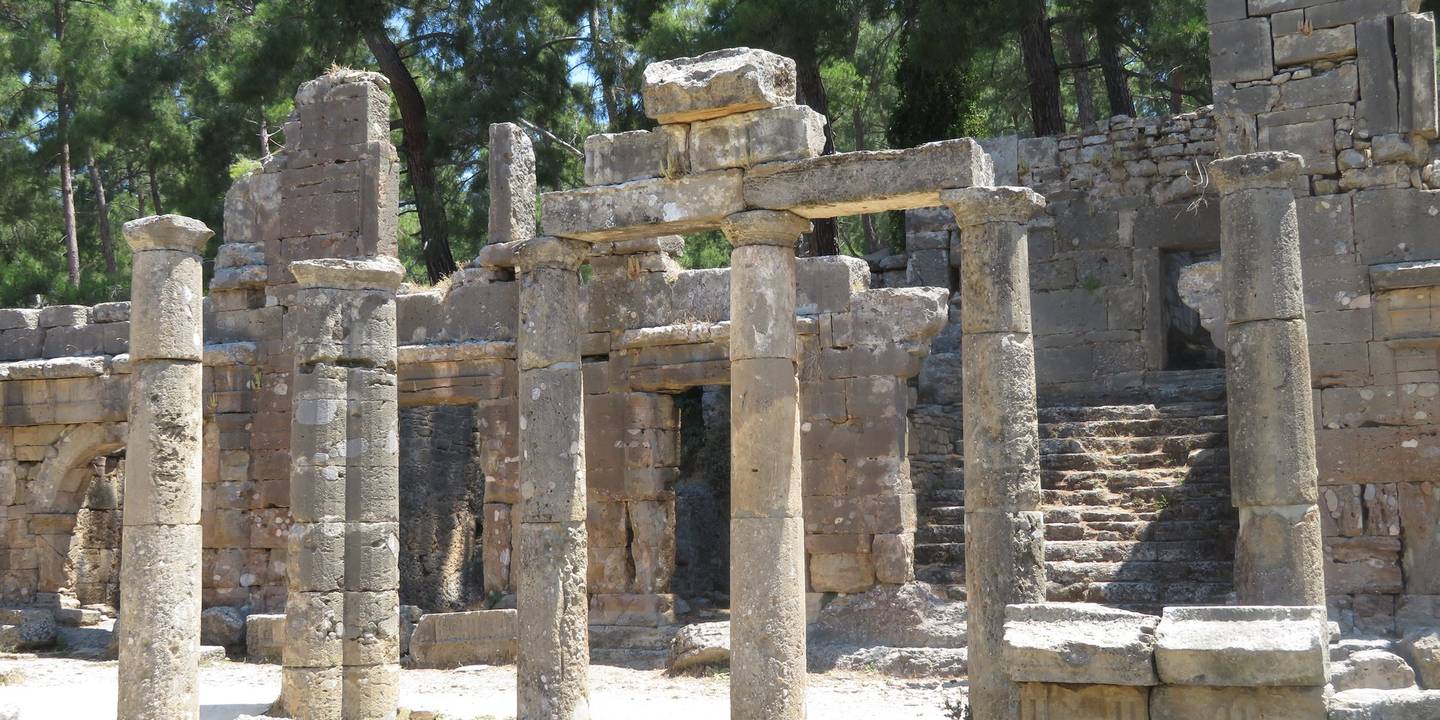
The Ancient City of Lyrbe, also widely known as Seleukeia, is a Pamphylian settlement hidden among pine forests near Bucakşeyhler in the Manavgat district of Antalya. Built on a hill bordered by deep ravines on three sides, the city is best known for its well-preserved agora, monumental gateway, fortification walls, galleries, baths, cisterns, church and necropolis areas. Older publications and travel sources identified the ruins as Seleukeia for many years. Current official accounts, however, state that the site was most probably Lyrbe, based on inscriptions in the Sidetic language, its mountainous location and evidence from ancient geography. The two names are still commonly used together, but Ancient Lyrbe is considered the more accurate identification. Current visitor notice: The Türkiye Cultural Portal of the Ministry of Culture and Tourism lists the Ancient City of Lyrbe as temporarily closed to visitors. Do not cross barriers or enter closed routes before an official reopening. Check the latest status through official sources before setting out.
No trips to this one just yet
Have a look at everything else you can book in Side.
All activities in SideWhere Is Seleukeia (Lyrbe) Ancient City and How Do You Get There?
The Ancient City of Lyrbe stands on a forested hill near Bucakşeyhler, in the Manavgat district of Antalya. It lies north of Side, inland at the foothills of the Taurus Mountains rather than on the Mediterranean coast.
Official directions advise travellers approaching from Side to turn before entering central Manavgat, continue past Manavgat Waterfall towards the reservoirs and follow the route to Bucakşeyhler. Map services may list the site under either “Lyrbe Ancient City” or “Seleukeia Ancient City.”
Keep the following points in mind when planning transport:
- By car: The rural route may include narrow and winding sections. Stay on the main road and follow official signs instead of taking unverified shortcuts suggested by navigation apps.
- By taxi or private transfer: A vehicle can be arranged from Side or Manavgat. Confirm the waiting time, return journey and total fare before departure.
- By public transport: Seasonal local services may operate towards Bucakşeyhler, but do not assume that a regular service reaches the archaeological site entrance.
- By tour: Lyrbe may appear in private cultural or countryside itineraries. While the site is closed, no tour should be expected to provide access to the ruins.
Because the ancient city is temporarily closed, this information is intended only to clarify its location and help with future planning.
The History and Main Ruins of Ancient Lyrbe
The earliest finds from Lyrbe date to the Classical period, while the visible remains mainly represent the Hellenistic, Roman and Byzantine eras. Deep ravines on three sides created a natural defensive position. On the southern approach, strong walls and a monumental gateway between two towers controlled entry into the settlement.
The principal remains include:
- An agora regarded as one of the best-preserved examples in Pamphylia
- A monumental entrance to the agora and a tetrapylon thought to be a later addition
- Gallery I and Gallery II on the western side
- A room interpreted as a library, where the Mosaic of the Seven Sages was found
- A bath complex, temples and cisterns
- The remains of a two-storey church
- Necropolis areas to the southeast and southwest
Between 1972 and 1979, an Istanbul University team led by Professor Jale İnan carried out excavations and research at the site. Sculptures and mosaics discovered during this work can be seen at Antalya Archaeological Museum, while several objects found by chance in later years entered the collection of Side Archaeological Museum.
Is Lyrbe Ancient City Open and Is There an Entrance Fee?
According to the latest official information, the Ancient City of Lyrbe is temporarily closed to visitors. It would therefore be misleading to provide a current entrance fee, Museum Pass arrangement or regular opening schedule.
| Visitor information | Current status |
|---|---|
| Entry to the ancient city | Temporarily closed |
| Opening hours | No active visitor schedule published |
| Entrance fee | No current tariff available |
| Museum Pass | No current arrangement announced |
| Guided visits | Dependent on an official reopening |
| Facilities and services | Regular visitor services should not be assumed |
Older blogs and past reviews may say that the site was free or accessible throughout the day. Those accounts do not override the current closure notice. Opening hours, ticket rules, vehicle access and safe walking routes may all change if the site reopens, so check official information close to your planned visit.
More to see around Side
Seleukeia (Lyrbe) Ancient City Travel and Information Guide
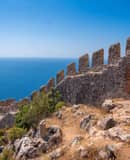
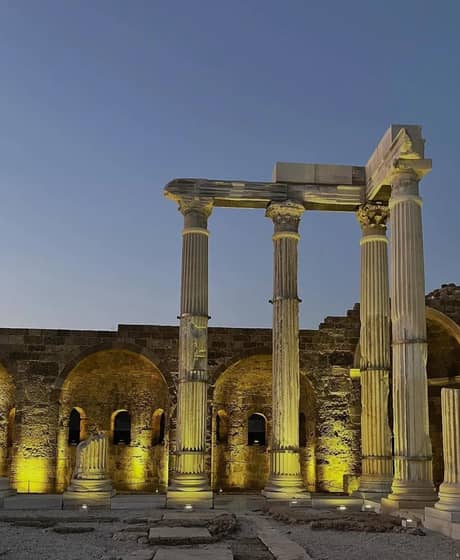
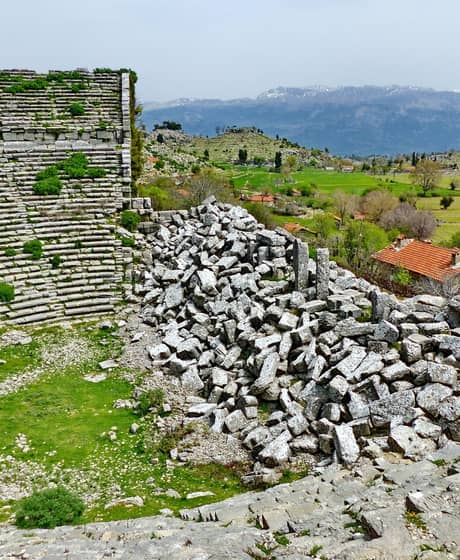
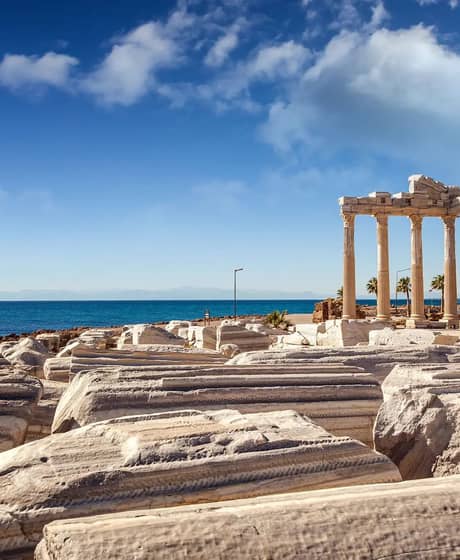
Unlike the coastal ancient cities around Manavgat and Side, Seleukeia (Lyrbe) occupies a wooded hill in the countryside. Its defensive walls, monumental entrance and agora surrounded by two-storey structures are the features most often seen in photographs of the ruins.
Lyrbe is significant not only for the condition of its architecture. The debate over the city’s true name, together with Sidetic inscriptions and evidence from ancient geography, also makes it important for understanding the history of Pamphylia. The current official notice states that the site is temporarily closed, so any visit should be postponed until an authorised reopening is announced.
What Is Seleukeia (Lyrbe) Ancient City?
Seleukeia (Lyrbe) is an ancient Pamphylian city near Bucakşeyhler in the Manavgat district of Antalya. Its mountainous position, defensive system and monumental public centre create a very different urban setting from the coastal city of Side.
The name Seleukeia was used so widely for many years that both names still appear on maps, travel websites and visitor reviews. Current official sources, however, generally introduce the ruins as Ancient Lyrbe.
Where Is Seleukeia Ancient City?
The ruins known in tourism sources as Seleukeia Ancient City are near Bucakşeyhler in Manavgat, Antalya. The official address is given as Bucakşeyhler, Manavgat Caddesi, 07330 Manavgat/Antalya, Türkiye.
The city is not in central Side or on the Mediterranean coast. It stands in the forested countryside north of Side and Manavgat. If your map displays Seleukeia Sidera in Isparta or Seleucia Pieria in Hatay, you have selected a different ancient city.
Is the Correct Name Seleukeia or Lyrbe?
Current official and academic accounts consider Lyrbe the most likely name of the site, although the identification debate is not regarded as completely settled because no inscription naming the city with absolute certainty has been found. Older publications associated the ruins with Seleukeia using information from the Stadiasmus Maris Magni, an ancient maritime route text.
Later research suggested that Seleukeia should instead be sought at another location accessible from the Manavgat River, probably on the coast west of Side. The mountain setting at Bucakşeyhler, Classical-period finds and inscriptions in the Sidetic language strengthen the identification with Lyrbe.
The page name “Seleukeia (Lyrbe) Ancient City” can therefore be used to meet both common searches, provided the naming question is explained accurately in the content.
What Does Lyrbe Mean?
Lyrbe is the proper name of the ancient city and has no established, universally accepted English translation. It is more accurate to retain it as an ancient place name than to treat it as a modern word with a literal meaning.
Inscriptions written in the Sidetic language suggest cultural and linguistic links between Lyrbe and Side. This connection does not mean that Lyrbe was a district of the Ancient City of Side; they were separate settlements.
What Does Seleukeia Mean?
Seleukeia, also written as Seleucia, was a name given to numerous cities connected with the Seleucid dynasty in the Hellenistic world. It can broadly be understood as “the city of Seleucus.”
Because several settlements across Anatolia and the Near East shared this name, a search for Seleukeia alone may produce the wrong destination. Use Lyrbe or Seleukeia Lyrbe for the Manavgat site, Seleukeia Sidera for the ruins in Isparta and Seleucia Pieria for the ancient harbour city in Hatay.
The History of Lyrbe Ancient City
The earliest archaeological finds at Lyrbe date to the Classical period, while the visible city contains layers from the Hellenistic, Roman and Byzantine eras. Its exact foundation date and early political history remain uncertain, so presenting it simply as a city founded by the Seleucid dynasty would not be reliable.
The Hellenistic character of the agora and defences shows that the settlement possessed a carefully planned public centre. During the Roman period, baths, temples, galleries and water structures developed around the city. Despite its mountain location, the surviving buildings suggest substantial civic activity. Church remains demonstrate that the settlement continued to be used in the Byzantine period.
When Was Lyrbe Excavated?
The principal archaeological excavations at Lyrbe took place between 1972 and 1979 under Professor Jale İnan and an Istanbul University team. The work documented sections of the agora, mosaics and sculptural objects, while conservation and repair made parts of the architectural layout easier to understand.
Many significant finds were moved to museums for protection rather than left at the site. Visitors should not assume that mosaics seen in online photographs remain on display among the ruins.
Why Is the Agora of Lyrbe Important?
The Agora of Lyrbe is regarded as one of the best-preserved examples in the ancient region of Pamphylia. Its western side rests against the slope, while two-storey buildings line the eastern edge. Galleries, passages and specialised rooms in the northern wing show that the agora supported administrative and social activity as well as trade.
The agora is entered through a monumental gateway on its southeastern side. A tetrapylon, designed as a four-support gateway, is thought to have been added later. Climbing onto upper levels or unstable sections would endanger both visitors and the archaeological remains.
Where Is the Mosaic of the Seven Sages?
The Mosaic of the Seven Sages discovered at Lyrbe is now displayed at Antalya Archaeological Museum. It was found in a room on the northern side of the agora that has been interpreted as a library because of its architectural function.
The original mosaic is not displayed at the ancient city. Anyone who specifically wants to see it should check the museum’s current exhibition arrangements, opening hours and admission rules separately.
What Can You See at Lyrbe?
The main archaeological remains at Lyrbe include:
- The southern fortification walls and monumental gateway between two towers
- The Hellenistic-style agora
- Gallery I and Gallery II
- The tetrapylon
- The room interpreted as a library
- The bath complex
- Remains of temples and cisterns
- A two-storey church
- The southeastern and southwestern necropolises
Even after reopening, not every structure should be assumed to be safe or accessible. Archaeological boundaries, conservation work and seasonal safety measures may alter the permitted visitor route.
Is Lyrbe Ancient City Open?
No. The Türkiye Cultural Portal of the Ministry of Culture and Tourism currently lists the Ancient City of Lyrbe as temporarily closed to visitors. Older blogs, map reviews or social media posts may say that it is open, but the latest official notice takes priority.
“Temporarily closed” does not mean that a confirmed reopening date is available. Do not attempt to enter the restricted site before an official reopening has been announced.
How Much Is the Lyrbe Ancient City Entrance Fee?
Because the site is closed, there is no current and valid Lyrbe Ancient City entrance fee. References to free entry in older reviews do not prove that the same arrangement will apply after reopening.
A ticket, Museum Pass rule, guided-entry system or controlled access procedure may be introduced. Admission information can only be confirmed after an official announcement or a current on-site tariff has been published.
What Are the Lyrbe Ancient City Opening Hours?
There are no applicable visitor hours while the site remains temporarily closed. Automated listings such as “open 24 hours” on map services should not be treated as an official archaeological-site schedule.
Summer and winter opening hours may differ if the site reopens. Check the last admission time, ticket office hours and any safety restrictions immediately before travelling.
How Do You Get to Lyrbe Ancient City?
Lyrbe is reached by road through the Manavgat Waterfall and reservoir direction towards Bucakşeyhler. Official directions advise travellers arriving from Side to take the left turn before entering central Manavgat, continue beyond the waterfall and follow the road towards the dams and Bucakşeyhler.
Phone reception and signage can be limited on rural roads. Downloading an offline map may help, but not every forest road suggested by navigation software is suitable for normal vehicles. While the site remains closed, do not travel to the entrance or cross official barriers.
Can You Reach Lyrbe by Public Transport?
Local transport may operate towards Bucakşeyhler, but a frequent service directly to the ancient city entrance should not be assumed. Routes, stops and the final return service can change by season.
After reopening, check current information with Manavgat Municipality, local transport operators or your accommodation. Ask whether the final section requires walking and confirm the condition and length of that route.
Is There Parking at Lyrbe Ancient City?
No official, organised and currently operating visitor car park has been confirmed for Lyrbe. Older reviews may mention areas where visitors once left their vehicles, but these accounts do not establish current capacity, safety or permission to park.
After reopening, follow on-site signs and staff instructions when leaving a vehicle. Never block forest roads, emergency access routes or entrances to private property.
How Long Do You Need at Lyrbe?
If the site reopens, allow approximately one to two hours to see the principal remains. Visitors who want to study the agora in detail, take photographs and move carefully across the uneven ground may need longer.
This estimate does not include transport. Travel from Side or Manavgat, parking and any controlled-entry procedures should be added to the schedule.
When Is the Best Time to Visit Lyrbe?
After an official reopening, mild spring and autumn days are likely to be more comfortable for walking across the forested, rocky terrain than the height of summer. Midday heat and wildfire risk matter in summer, while rain can make the ground slippery in winter.
Check the weather, any restrictions on entering forest areas and the archaeological site’s open or closed status together. Fine weather alone does not mean that entry is permitted.
What Should You Bring to Lyrbe?
If the site reopens, useful items may include:
- Walking shoes with non-slip soles
- Sufficient drinking water
- A hat and sun protection
- Clothing suitable for the season
- A charged phone and an offline map
- A small first-aid kit
Do not assume that a kiosk, toilets, shade or a visitor centre will be available. Never light a fire, discard cigarette ends in the forest or touch the archaeological remains.
Is Lyrbe Suitable for Children and Visitors with Limited Mobility?
The rocky, sloping and sometimes uneven terrain may be difficult for young children, pushchairs and visitors with limited mobility. If the site reopens, check whether an accessible route has been introduced.
Children should be supervised continuously near ravines, walls and elevated ruins. Climbing on the remains or leaving the marked visitor route is unsafe.
What Do Photos of Seleukeia Lyrbe Show?
Photos of Lyrbe most often show the two-storey façades of the agora, stone galleries, the monumental gateway, fortification walls and paths through the pine forest. Some viewpoints also look towards Oymapınar Dam and its surrounding landscape.
Check when online images were taken. Older photographs may not reflect current vegetation, maintenance conditions, safety barriers or the closure of the site.
How Should You Interpret Reviews of Seleukeia Lyrbe?
Past reviews frequently praise the quiet atmosphere, well-preserved agora, forest setting and distance from large crowds. A narrow approach road, limited signage, weak phone reception and a lack of visitor facilities are also commonly mentioned.
Statements such as “free,” “open 24 hours” or “no staff at the entrance” describe past experiences, not current permission to enter. Official closure and reopening notices should guide any decision to visit.
Are Seleukeia Sidera and Lyrbe the Same Place?
No. Seleukeia Sidera is a separate ancient city near Bayat village in the Atabey district of Isparta. It is confused with Lyrbe because the name Seleukeia was used for several cities in the ancient world.
| Ancient city | Present-day location | Key distinction |
|---|---|---|
| Seleukeia (Lyrbe) | Bucakşeyhler, Manavgat, Antalya | Forested Pamphylian city with a monumental agora |
| Seleukeia Sidera | Bayat village, Atabey, Isparta | A separate settlement in the ancient region of Pisidia |
| Seleucia Pieria | Çevlik, Samandağ, Hatay | Ancient harbour city near the Titus Tunnel |
Where Is Seleucia Pieria Ancient City?
Seleucia Pieria is an ancient harbour city around Çevlik in the Samandağ district of Hatay. It belongs to the same historic area as the Titus Tunnel and Beşikli Cave.
Seleucia Pieria in Hatay, Seleukeia Sidera in Isparta and Lyrbe in Manavgat are three different archaeological sites. Always check the province and district when planning a route.
What Can You Visit Near Lyrbe?
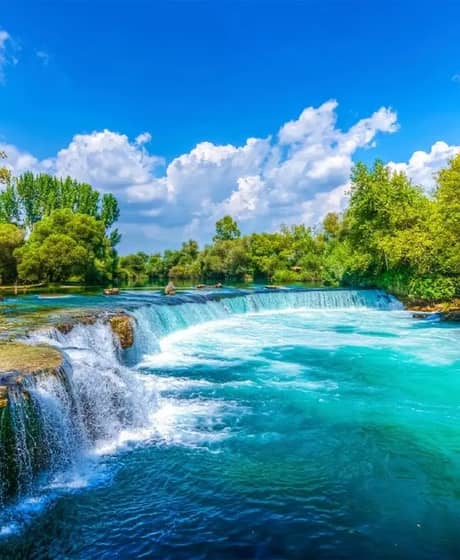
If Lyrbe reopens, its forested archaeological setting can be combined with historical and natural attractions around Manavgat and Side. For a broader itinerary, explore Maxtoria’s guide to the best places to visit in Manavgat.
Travellers who want to continue with ancient history can visit Side Ancient City, while those looking for a nature stop can add Manavgat Waterfall. These nearby attractions can also serve as alternatives while Lyrbe remains closed.
How Should You Plan a Visit to Seleukeia (Lyrbe) Ancient City?
The first step is to confirm that the site has officially reopened. Once a reopening notice has been published, check visiting hours, admission arrangements, road conditions and the weather together.
A sensible planning order is:
- Confirm the open or closed status through official Ministry of Culture and Tourism sources.
- Check the Manavgat–Bucakşeyhler route and any current roadworks.
- If using public transport, confirm the final return service in advance.
- Bring water, sturdy footwear and sun protection.
- Remain on the marked visitor route and do not climb on the ruins.
- If Lyrbe is still closed, choose an open alternative such as Side Ancient City or Manavgat Waterfall.
This approach supports both a safer trip and the protection of archaeological remains within the forested landscape.
Our easy-to-use app offers a comprehensive listing of curated tours, activities, and experiences, all in one place. Whether you’re a thrill-seeker looking for an adrenaline-packed adventure or seeking a more relaxed getaway, Maxtoria has got you covered.





© 2026 Maxtoria Turizm Ticaret A.Ş. — All Rights Reserved
v2.1.2