









 Popular
Boat Tours
From Marmaris: Pirate Boat Trip / Lunch & Unlimited Soft Drinks
Free Cancellation Free Shuttle
From £24.32 £21.60 Per Person



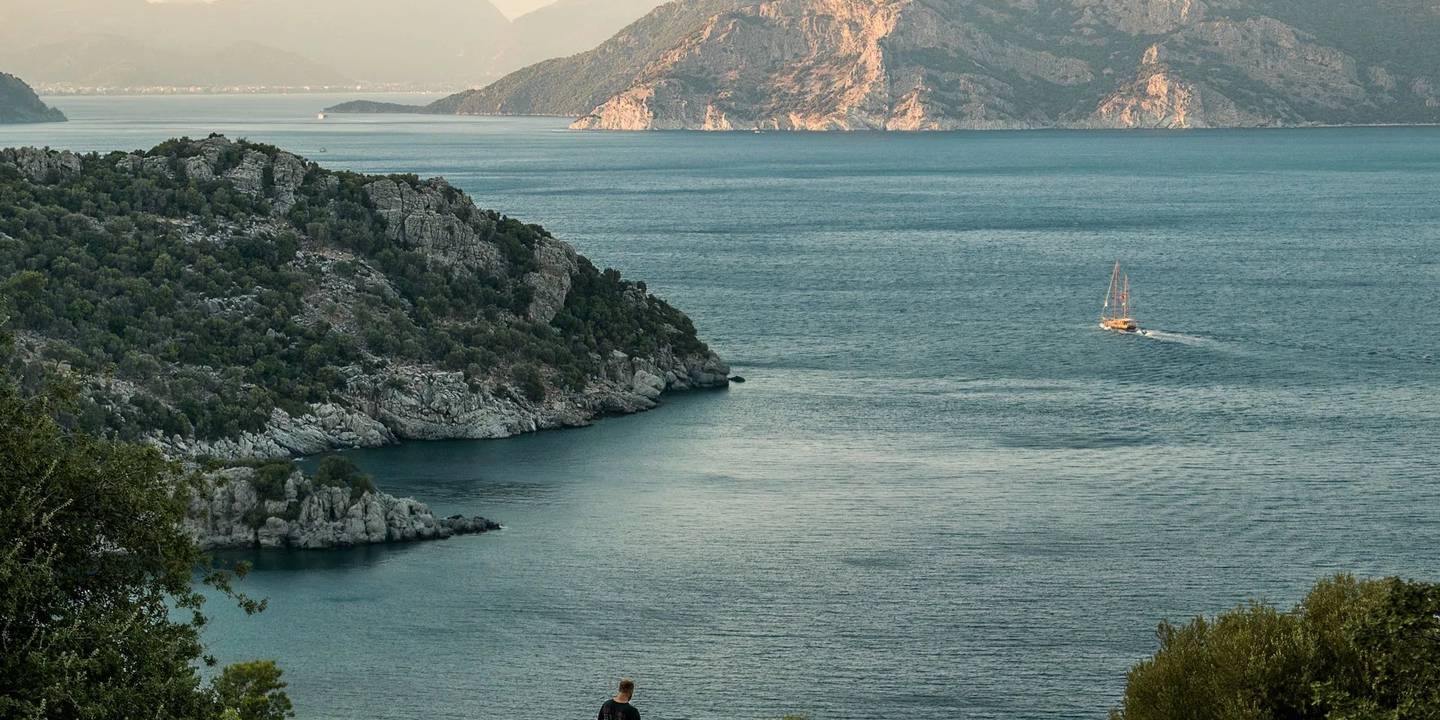
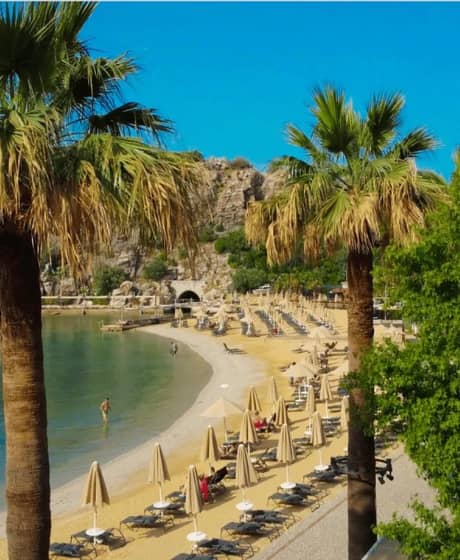
Amos Bay is a small, natural swimming spot in the Marmaris district of Muğla, between Turunç and Kumlubük. Its clear sea, pebble shore and the ancient city of Amos above the bay make it possible to combine swimming and history on the same route. Located approximately 24–25 kilometres from central Marmaris, the bay can be reached by private car, seasonal public transport services or suitable boat tours. Beach services at Amos may be operated seasonally by a private business, so entrance, sunbed, parking and food-and-drink arrangements can change during the season. As the bay is small, it is useful to arrive early in summer and bring water shoes, sun protection and drinking water. When combined with the ancient theatre and viewpoint above the bay, the visit becomes a well-balanced half-day trip.
Tours and trips that go here, run by licensed local operators.
Amos Bay is located on the coastline between Turunç and Kumlubük in the Marmaris district of Muğla, approximately 24–25 kilometres south of central Marmaris.
From Marmaris, follow the road towards İçmeler and Turunç, then continue in the direction of Amos and Kumlubük after Turunç. Most of the road is paved, but some sections may be narrow, winding and steep. With summer traffic, the journey can take approximately 40–60 minutes.
The main transport options are:
By car: Follow the Marmaris–İçmeler–Turunç–Amos route. Drive carefully on the narrow final section, which has sharp bends and limited parking.
By public transport: MUTTAŞ route 10-15 towards Marmaris–Turunç may also cover the Kumlubük/Amos route. Check on the day of your visit whether the service continues as far as Amos and when the last return journey departs.
By taxi: A taxi can be taken from Turunç or central Marmaris. Discuss the availability of a return vehicle in advance.
By boat: Some boat tours departing from Marmaris, İçmeler or Turunç may stop at Amos Bay for swimming. If you specifically want to see the bay, confirm the itinerary before booking.
On foot: It is possible to walk from Turunç towards Amos, but summer heat, vehicle traffic, gradients and narrow road sections must be considered. There may not be an uninterrupted pavement along the entire route.
Navigation results may include Amos Bay, Amos Beach, Amos Ancient City or Kumlubük Amos. Visitors heading to the beach and those visiting the ancient city should not automatically select the same point, as the turn-offs and parking areas may differ.
Amos Bay is a natural coastal area, but the private business serving the beach may apply an entrance fee, sunbed charge, parking fee or minimum-spend requirement. There is no fixed public entrance tariff valid throughout the year.
| Area or service | How should the current situation be assessed? |
|---|---|
| Access to Amos Bay | There is no standard archaeological-site ticket for using the road |
| Beach business | Entrance, sunbed or spending conditions may change seasonally |
| Parking | Capacity and charges may vary |
| Showers, toilets and changing facilities | Depend on whether the business is open and which services it provides |
| Restaurant and drinks | Charged separately |
| Amos Ancient City | Separate from the beach; there may be no ticket office under the current visiting arrangement |
| MüzeKart | Usually not required at an open site without a ticket office |
Old prices found online should not be treated as current. Entrance charges, per-person fees, sunbed packages, parking and rules on bringing outside food may change even within the same season. Contact the beach business for current conditions before setting out.
Amos Bay does not have official opening and closing hours as a natural area; the beach business, parking facilities and service points keep their own hours. Visiting the ancient city in daylight is safer because of its rocky paths and steps.
Amos Bay and Amos Ancient City on the hillside are close to one another and can be visited within the same half-day programme.
Suggested itinerary:
Arrive at Amos Bay in the morning.
Ask about parking, entrance and beach-use conditions.
Allow 2–3 hours for swimming and relaxing.
Move towards the ancient-city path after the midday heat begins to ease.
Follow the rocky path to the theatre and city-wall remains.
Enjoy the views over the bay and Kumlubük.
Stop for a meal in Turunç or Kumlubük on the return journey.
The ancient-city route may include steps, uneven stones, steep paths and unprotected sections. Wear shoes with good grip, carry enough water and keep away from cliff edges. Beach sandals may not be suitable for the walk through the ancient city.
Visitors who want to see the ancient city before swimming in midsummer should begin very early. On an afternoon visit, finish the ancient-city walk before sunset and do not remain on the path after dark.
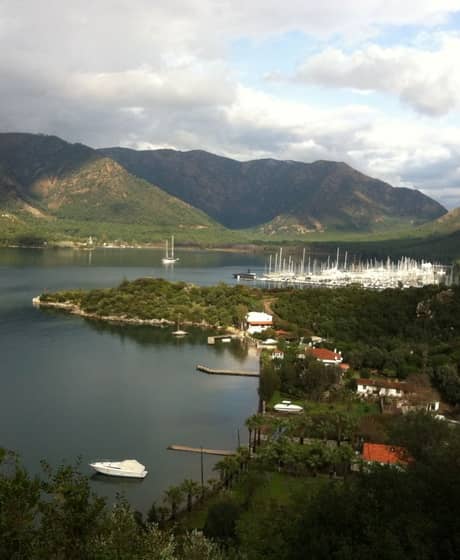
Amos Bay is a small bay on the southern coast of Marmaris where sea, nature and archaeology meet. It lies on the route towards Kumlubük after Turunç. The bay's clear water and pebble shore provide a pleasant swimming stop, while Amos Ancient City above it adds a historical dimension with its theatre and views across the gulf.
It would be incomplete to consider Amos only as a beach. The area brings together a beach business, a natural coastline, a boat-tour swimming stop and an ancient city. Access and usage conditions may differ in each part.
Amos Bay is in the Marmaris district of Muğla Province. Administratively, it forms part of the southern coastal route around Turunç neighbourhood, which belongs to Marmaris.
The bay is not on the same urban shoreline as central Marmaris. Visitors must cross the winding mountain road through İçmeler and Turunç. Although the distance may look short on a map, the road layout and summer traffic can extend the journey time.
Amos Bay lies between Turunç and Kumlubük and is associated with both areas. Search results may use names such as “Turunç Amos Bay”, “Kumlubük Amos” or “Amos Beach Marmaris”.
Turunç is one of the nearest tourist settlements north of the bay, while Kumlubük is the broader coastal area continuing to the south. Amos Ancient City stands on the rise northwest of Kumlubük Bay known as Asarcık or Hisarburnu.
Amos Bay is the name of the natural coastal area, while Amos Beach refers to the part used for swimming where commercial beach services may be available. In everyday use, the two names usually refer to the same place.
The entire bay should not be assumed to be a private beach. Nevertheless, access to the shore, parking and beach services may be arranged through a particular business or residential-site entrance. Follow the current signs and respect private-property boundaries during your visit.
No. Amos Bay is the swimming area on the coast, while Amos Ancient City is the archaeological settlement on the hill above it. They are close enough to visit on the same trip.
The vehicle road to the beach and the starting point of the path to the ancient city may differ. Choosing the wrong navigation destination could direct your vehicle onto an unsuitable road. Decide which area you want to visit first before setting out.
Yes, Amos Bay can be reached by private car from Marmaris via İçmeler and Turunç. The final section of the road may narrow, and parking can be insufficient during the high season.
While driving:
Watch for oncoming traffic on bends.
Do not park randomly along the roadside.
Do not leave glass, cigarette ends or flammable materials in the forested area.
Avoid unmarked shortcuts suggested by navigation applications.
Account for lighting and visibility on the return journey after dark.
Arriving early in the morning during high season may make it easier to find a parking space.
It may be possible to reach the Amos or Kumlubük area by using public transport services towards Marmaris–Turunç. The published route for MUTTAŞ line 10-15 between Marmaris and Turunç also includes Kumlubük/Amos.
However, not every vehicle may continue to the same final stop. Service frequency, weekend timetables and the last return journey can vary by season. Check the current MUTTAŞ timetable on the day of your visit and, if necessary, confirm the Amos stop and return option with the driver.
Another option is to get off in Turunç and continue to the bay by taxi. Walking along the narrow, steep road in the summer heat may not be suitable for everyone.
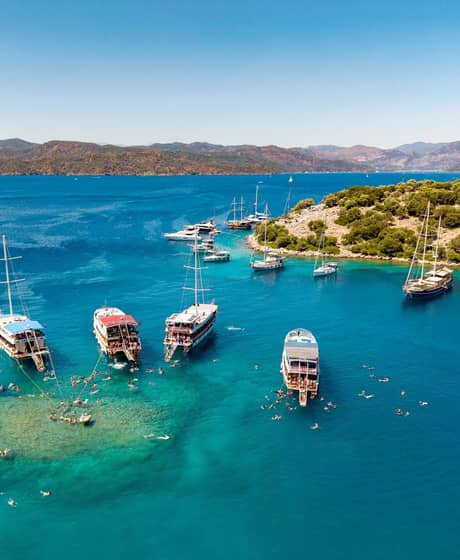
Yes, some day boats departing from Marmaris, İçmeler or Turunç may stop at Amos Bay for swimming. The bay can also be visited by private boat or yacht.
Going ashore is not always guaranteed on a boat tour. Some programmes only provide an offshore swimming stop. Visitors who also want to explore Amos Ancient City should ask before booking whether passengers can disembark and how much waiting time is provided.
The route may change according to wind, waves and boat traffic. The word “Amos” in an itinerary may sometimes refer to a view of the bay or a swimming point nearby.
The general route from central Marmaris is:
Travel towards İçmeler.
Turn onto the Turunç road from İçmeler.
Follow the mountain and coastal road to Turunç.
Continue from Turunç towards Kumlubük and Amos.
At the signs for Amos Beach or Amos Ancient City, take the turn-off for your chosen destination.
The approximately 24–25-kilometre journey from central Marmaris cannot be covered as quickly as a level urban road because of the bends. It may take less time without traffic, but allowing at least 45–60 minutes is safer during busy periods.
There may be places to leave vehicles around the bay and beach business, but parking capacity is limited and the conditions of use can change seasonally.
Do not assume that parking is included in beach admission, charged separately or reserved only for customers of the business. Park without obstructing access and follow the instructions of staff.
If you plan to visit the ancient city, ask whether there is direct access from the beach car park to the start of the walking route. There are private residential and property areas nearby, so closed roads must not be used.
Amos Beach does not have a single official entrance fee valid throughout the year; entrance, sunbed, parking or minimum-spend requirements applied by the private operator may vary by season.
This is why very different prices from different years appear online. When requesting current information, ask about all of the following:
Entrance fee per person
Use of sunbeds and parasols
Parking charge
Minimum spend or voucher arrangement
Child pricing
Policy on outside food and drinks
Cash and card payment options
Do not plan your budget using only a price mentioned in an old review.
Amos Ancient City is an open archaeological area and may not have a fixed ticket office or regular admission system under the current visiting arrangement. Check on the day of your visit whether a MüzeKart is required or whether access has changed because of excavation or conservation work.
Any charge collected by the beach business is not an entrance ticket for the ancient city. Likewise, free access to the ancient city does not mean that sunbeds, parking and commercial beach services are also free.
Yes, Amos Bay is a popular natural coastal spot for swimming because of its clear sea. The shore is mostly pebbly and stony, so water shoes can make the visit more comfortable.
Sea conditions may change with the wind, boat movement and season. Calm, clear water does not mean that every part is shallow. Observe swimming boundaries, buoys and staff warnings.
The sea at Amos Bay may become deep quite quickly in some sections after entering from the shore. The depth and seabed can vary across the beach.
Non-swimmers and young children should remain close to shore and use suitable flotation aids when necessary. Be aware of marine traffic when swimming in open sections that boats can approach.
The stony seabed can affect balance, and wet rocks may be slippery.
Amos Bay can be visited with children, but constant adult supervision is required because of the pebble shore, changing depth, limited space and summer crowds.
Recommendations for families include:
Arrive early in the morning.
Bring water shoes suitable for children.
Ask in advance about shaded areas.
Observe the sea depth close to shore.
Check sunbed, shower and toilet arrangements with the beach business.
Keep children away from cliffs and wall edges on the ancient-city path.
A pushchair may not be suitable for the stepped, rocky route through the ancient city.
Yes, Amos Bay can be suitable for snorkelling on days when the water is calm and visibility is good. Rocky edges and the stony seabed may offer opportunities to observe small fish.
Do not touch marine life, feed fish or remove stones or living organisms from the water. Remain within the marked swimming area and away from boat routes.
When snorkelling, do not swim far from shore alone. Raise your head regularly to check for nearby boats and other swimmers.
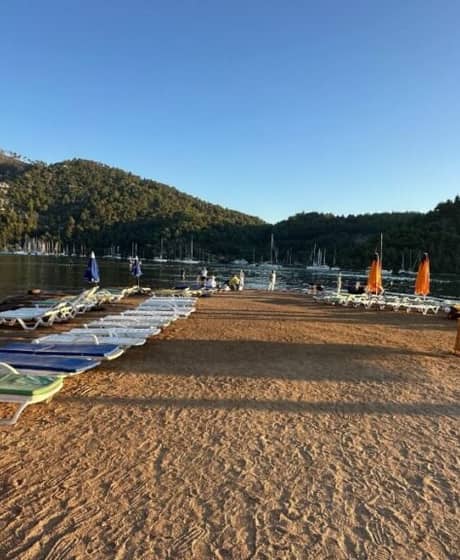
Some of the following services may be available when the business at Amos Beach is operating:
Sunbeds and parasols
Restaurant or snack bar
Toilets
Showers
Changing area
Parking
Sea ladder or jetty
Do not assume that every service is available each season or included in the entrance charge. Turunç can be considered for a wider choice of nearby shops and services.
The rule on bringing outside food and drinks depends on the current policy of the beach operator. At certain times, outside products may not be accepted or may be allowed only in designated areas.
If you need to bring special-diet food, baby food or health-related products, ask the business before visiting. Carrying enough drinking water is useful in all cases.
Do not use glass bottles in the natural area, leave rubbish behind or allow disposable items to blow into the sea.
Amos Bay should not be treated as an organised, official campsite. Unauthorised camping or overnight stays may not be permitted because of private property, the beach business, the archaeological area and forest regulations.
Visitors wishing to camp should choose a licensed campsite and check current notices concerning fires, barbecues and forest-entry restrictions. On days with a high summer fire risk, even a small flame or cigarette end can create serious danger.
At Amos Ancient City, visitors can see an ancient theatre, temple traces, city walls, statue bases and a necropolis. The walls surrounding the city are reported to be approximately 2 metres thick and to reach 3–4 metres in height in some sections.
The main remains include:
The ancient theatre, with some seating rows preserved
High wall sections of the theatre
Temple traces associated with a principal goddess or sacred area
Inscriptions connected with the cult of Apollo Samnaios
An altar of Dionysus
City walls reinforced with towers
The main northern entrance gate
A necropolis containing Carian-style graves
Rather than a large, formally arranged archaeological site, Amos is a small area of ruins to explore in a natural setting. Do not climb on structures or damage the stones.
The exact foundation date of Amos is unknown. The ruins and inscriptions found in the area show that the settlement was particularly active during the Hellenistic period.
Lease inscriptions examined by Professor George E. Bean in 1948 and dated to approximately 200 BC provide information about the city's economic and religious life. Amos is regarded as a Carian settlement connected with the territory controlled by Rhodes on the opposite mainland coast, known as the Rhodian Peraea.
Because the exact foundation date is unknown, it is not accurate to describe Amos as a city established in one specific year.
The Ancient Theatre of Amos is important because it is one of the few known theatres in Rhodes' historical mainland territory and because of its position overlooking the Gulf of Kumlubük.
Some seating rows and wall sections reaching approximately 6 metres in height are reported to have survived. The structure is not as large as the theatres of major ancient cities; much of its appeal comes from its relationship with the natural landscape.
The steps may be uneven and worn. Do not walk backwards without checking your footing while taking photographs, and do not climb onto the walls.
Although the exact origin of the name Amos is unknown, it may be an ancient Anatolian word related to the Luwian or Carian languages. Some interpretations suggest a possible connection with a mother-goddess cult.
The name is notably the same as that of the prophet Amos in the Old Testament, but this similarity does not prove a direct connection with the ancient city. The archaeological settlement should be considered within its Carian and Rhodian Peraea historical context.
Amos Ancient City and the higher points around it are suitable for views across the bay and Kumlubük. The direction of the light and the sun's position in relation to the sea change with the season.
If visiting near sunset, leave enough daylight for the return walk. The path, stone steps and junctions become more difficult after dark. It is not safe to stay late and rely only on a phone light.
The most comfortable periods for visiting Amos Bay are May–June and September–October. During these months, the weather, sea and walking conditions may be more balanced than in July and August.
Spring: Suitable for the ancient-city walk and natural scenery, although the sea may be cool.
June: A strong choice for combining swimming with walking.
July and August: The sea is warm, but the bay, road and parking area can be busier.
September: The sea remains warm on most days, while the air may feel more comfortable.
October: Can be suitable for a quieter visit, although beach services and transport frequency may decrease.
Winter: The bay can still be seen, but beach services, public transport and sea conditions may be limiting.
In summer, visit the beach early in the morning and the ancient city when the strength of the sun has eased.
| Visit plan | Suggested time |
|---|---|
| Short swim and photography stop | 1–2 hours |
| Relaxing on the beach | 3–4 hours |
| Amos Ancient City | 1–1.5 hours |
| Bay and ancient city together | Half a day |
| Turunç–Amos–Kumlubük route | Full day |
The total time varies according to parking, walking pace, how busy the business is and the time spent at the ancient city. Summer traffic can lengthen the return journey.
Visitor reviews most frequently praise the clear sea, the bay scenery and the gulf view from the theatre at Amos Ancient City.
Positive reviews commonly highlight:
Clean and clear water
Underwater visibility suitable for snorkelling
A small, natural bay atmosphere
The opportunity to combine it with Amos Ancient City on the same day
The view from the ancient theatre
Proximity to Turunç and Kumlubük
Common criticisms concern entrance and sunbed fees, restaurant prices, the narrow road, limited parking, high-season crowds and the pebble shore. As comments about prices may refer to different years, they should not be treated as current rates.
The main photography points around Amos include:
Safe viewpoints along the road descending towards the bay
The rocky coast seen from the beach
Views from the water back towards the shore
The seating rows of the Ancient Theatre of Amos
Views of Kumlubük and the bay from the theatre
The ancient city walls and olive-tree-lined path
Do not stop suddenly on the road to take photographs, enter private property or approach cliff edges. Before flying a drone, check the rules for the archaeological site, the private business and civil aviation.
Amos Bay lies midway along the Turunç and Kumlubük route on the southern coast of Marmaris. The main nearby places include:
Amos Ancient City
Turunç Beach and village centre
Kumlubük Beach
Amos and Kumlubük viewpoints
İçmeler Beach
İçmeler coastal promenade
Phosphorous Cave
Kadırga Bay
Çiftlik Bay
Gebekse Bay
Marmaris Castle and Old Town
On a full-day road trip, you can visit Turunç in the morning, Amos Bay around midday, Amos Ancient City in the afternoon and Kumlubük in the evening. Set your return time in advance to avoid driving the winding road after dark in summer.
A visit to Amos Bay should be planned as a half-day or full-day trip after deciding on your transport and beach expectations.
Before setting out, check:
Road and forest-access conditions
Whether public transport continues as far as Amos
The last return service
Beach entrance and sunbed arrangements
Parking capacity and charges
Policy on outside food
Access conditions at the ancient city
Weather, wind and sea conditions
Plans for Turunç or Kumlubük on the return route
Three to four hours may be sufficient for the beach alone. If you also want to see the ancient city and nearby settlements, a full day provides a more comfortable trip.
Some boat trips departing from Marmaris include Amos Bay or nearby swimming spots in their programme. The Pirate Boat Trip from Marmaris on Maxtoria combines Paradise Island, Aquarium Bay, Phosphorous Cave, Amos, Turunç and several swimming stops in its published itinerary.
If you specifically want to go ashore in the bay or explore Amos Ancient City, ask before booking whether the tour only provides an offshore swimming stop. The route may change according to weather and sea conditions.
You can compare other options on the Marmaris tours and activities page. To plan routes by land and sea, explore the guides to the best places to visit in Marmaris and the best beaches and bays in Marmaris.
Our easy-to-use app offers a comprehensive listing of curated tours, activities, and experiences, all in one place. Whether you’re a thrill-seeker looking for an adrenaline-packed adventure or seeking a more relaxed getaway, Maxtoria has got you covered.





© 2026 Maxtoria Turizm Ticaret A.Ş. — All Rights Reserved
v2.1.2